
Two deep groove ball bearings can have the same bore, outside diameter and width, yet behave quite differently once installed. A bearing marked ZZ normally uses metal shields on both sides, while a 2RS bearing uses rubber seals. The difference may look minor, but it affects running torque, heat generation, speed capability, grease retention and resistance to contamination.
The usual explanation – ‘ZZ is for speed, 2RS is for protection’ – is directionally correct but incomplete. Some machines operate in clean housings but experience high temperatures. Others run slowly but face abrasive dust, condensation or occasional liquid splash. There are also low-friction rubber seals and non-contact elastomer seals that do not behave like a conventional contact seal.
The right choice depends on the failure risk that matters most in the actual machine. If contamination is likely to reach the rolling contacts, stronger sealing may extend service life even though it adds friction. If the bearing is already protected by the housing, the additional drag of a contact seal may provide little benefit.
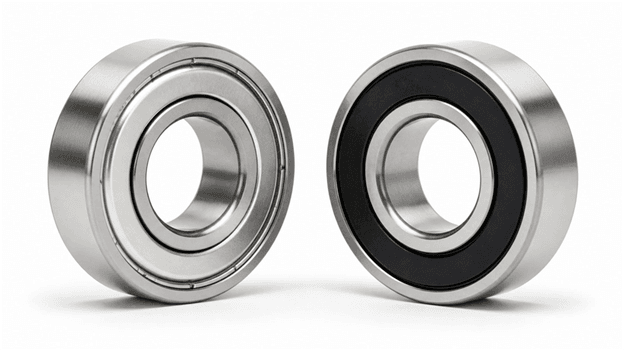
ZZ metal shield (left) and 2RS rubber seal (right).
1. What ZZ and 2RS Actually Describe
A Z suffix generally indicates a metal shield on one side of the bearing. ZZ or 2Z indicates shields on both sides. The shield is usually formed from sheet steel and fixed to the outer ring. Its inner edge runs close to the inner ring but does not normally touch it. This narrow gap helps retain grease and blocks larger particles without adding a rubbing seal lip.
Because the shield is normally non-contact, it adds very little friction. Shielded bearings are therefore common in electric motors, fans, power tools and other equipment where low starting torque, limited heat generation or relatively high rotational speed is important. The same gap is also the main limitation: fine dust, moisture and liquid can still enter, especially when contamination is driven toward the bearing by airflow, gravity or pressure. A ZZ bearing should never be treated as waterproof.
An RS suffix generally refers to an elastomer seal on one side, while 2RS indicates seals on both sides. The visible sealing element is often nitrile rubber bonded to a steel reinforcement. In a conventional contact design, the seal lip runs against a surface on the inner ring, closing the path that remains open in a shielded bearing. This improves exclusion of fine dirt and splash water and usually provides better grease retention, but the sliding contact also raises starting torque, running torque and temperature.
‘2RS’ is a generic purchasing term rather than a universal seal specification. SKF uses suffixes such as 2RS1, 2RSH and 2RSL; NSK uses DDU, DDW and VV; Schaeffler uses 2HRS, 2ELS and 2BRS. A 6203-2RSH or 6203-2RS1 bearing is a useful example of why the complete manufacturer designation matters. Depending on the design, the elastomer seal may be contact, light-contact or non-contact, and its friction, material and limiting speed can differ substantially.
For this reason, two products sold as ‘6205-2RS’ may be dimensionally interchangeable without delivering identical operating performance. The full designation, seal construction, grease specification and speed data should be checked whenever temperature, efficiency or contamination control is important.
2. How the Closure Changes Bearing Performance
The largest practical difference is not load capacity. Adding a rubber seal does not normally increase the bearing’s catalogue dynamic load rating. Its value comes from protecting the grease and rolling contacts. In a contaminated environment, that protection can influence service life more than a small difference in theoretical load capacity.
A clean bearing with slightly higher seal friction may outlast a low-friction bearing that admits abrasive dust. Once hard particles enter, they can indent the raceways, damage the lubricant film and accelerate noise, vibration and fatigue. In this situation, accepting additional torque from a 2RS seal is usually a reasonable trade.
In a clean, high-speed application, the priorities are different. Seal friction becomes a continuous source of heat. Higher temperature reduces grease viscosity and accelerates lubricant deterioration. If the bearing is already enclosed inside a clean motor or gearbox, a ZZ version may operate cooler and waste less power without creating a meaningful contamination risk.
This effect is particularly important in small motors, low-power drives and equipment with limited starting torque. The friction of one seal may be modest, but a machine containing several sealed bearings can show a measurable difference in startup current, efficiency and temperature. This does not mean that every motor should use ZZ; it means that sealing should not be added without considering the cost of additional drag.
| Selection factor | ZZ / 2Z metal shields | 2RS rubber seals |
| Sealing method | Normally non-contact, with a small gap at the inner ring | Usually uses a sealing lip; exact contact design depends on the manufacturer |
| Contamination | Suitable for clean or lightly contaminated environments | Generally better against fine dust, dirt and occasional splash |
| Friction and heat | Very low sealing friction and relatively low heat | Contact seals increase torque and heat |
| Speed capability | Usually preferred where higher speed is required | May be lower than the equivalent shielded version |
| Grease retention | Good in normal service, although the gap remains open | Usually better, particularly at low and moderate speeds |
| Water resistance | Not waterproof | Better against splash, but not automatically suitable for immersion or pressure washing |
| Typical applications | Motors, fans, clean gearboxes and enclosed drives | Conveyors, agricultural machinery, material handling and exposed mechanisms |
The table describes the usual behavior, not a fixed rule for every bearing. Modern low-friction contact seals can run faster than older designs, while some non-contact rubber seals approach the low torque of a metal shield. The published speed rating for the exact part number should take priority over assumptions based on the suffix.
Temperature also deserves more attention than it usually receives. A ZZ shield itself adds little friction, but the bearing is still limited by its grease, cage, internal clearance and surrounding fits. In a 2RS bearing, the rubber compound and seal-lip temperature create additional limits. Prolonged operation outside the material’s rated range can cause hardening, loss of elasticity or accelerated wear.
Grease behavior is another reason not to compare the closures in isolation. A shielded bearing at high speed may experience grease movement or leakage even though the shield is intact. A contact seal retains grease more effectively, but overfilling or excessive heat can still cause leakage. The complete bearing specification matters more than the visible closure alone.
3. Where ZZ and 2RS Work Best
ZZ is normally the stronger choice when the bearing operates in a clean enclosure and speed, efficiency or low starting torque has priority. Typical examples include electric motors, ventilation fans, indoor power tools and enclosed transmission systems. In these machines, the housing already acts as the primary barrier against contamination.
A shielded bearing can also be useful where seal drag would affect control accuracy or available power. Small motors, precision instruments and lightly loaded high-speed shafts may not tolerate unnecessary friction. Lower heat generation can help protect the grease when rotational speed is high.
ZZ becomes a poor choice when the bearing is directly exposed to fine powder, outdoor moisture, process debris or liquid spray. The shield may stop larger particles, but it cannot close the non-contact gap. Replacing an open bearing with ZZ may improve the situation without solving the actual contamination problem.
A 2RS bearing is usually more appropriate for conveyors, agricultural equipment, woodworking machinery, material-handling systems and other exposed equipment. At low or moderate speed, the additional seal friction may have little practical effect compared with the benefit of keeping abrasive contaminants away from the raceways.
A product page that offers both 6300ZZ and 6300-2RS bearing options illustrates an important purchasing point: identical boundary dimensions do not remove the need to specify the correct closure. The machine environment, speed and available torque still decide which version is suitable.
A standard 2RS bearing is not a substitute for a complete machine-sealing system. High-pressure washdown can force water past the seal lip. Continuous water exposure, immersion, corrosive chemicals or large pressure differences may require a special multi-lip seal, corrosion-resistant materials, an external labyrinth, a flinger or a separate shaft seal.
The shaft, housing and covers also matter. Dirt can enter around the bearing seat rather than through the bearing seal, and water may collect because the housing has no drainage path. In severe contamination, improving the enclosure can produce a larger reliability gain than changing from ZZ to 2RS alone.
4. A More Reliable Way to Choose
Begin with the environment rather than the suffix. Identify what can realistically reach the bearing: fine dust, fibres, metal particles, condensation, rain, coolant or wash water. Then determine whether the bearing is directly exposed or protected by another enclosure.
Next, check operating speed and available torque. Do not assume that every 2RS bearing has the same speed penalty. Compare limiting speed, friction information and temperature range for the exact manufacturer designation. This is particularly important for small motors, low-temperature starts and equipment running close to the catalogue speed limit.
The seal material must also be compatible with temperature and any chemicals present. A rubber seal that performs well in a dry conveyor may not be suitable for hot oil, aggressive cleaning fluids or continuous outdoor exposure. When compatibility is uncertain, use the manufacturer’s seal data rather than the colour or appearance of the seal.
Review bearing internal clearance at the same time. A bearing that runs hotter because of seal friction, tight interference fits or high speed may lose more operating clearance than expected. Changing from ZZ to 2RS without checking temperature and clearance can solve a contamination problem while creating an overheating problem.
Finally, compare the complete bearing codes. Confirm the seal type, grease, clearance, cage, temperature range and speed rating. Catalogue dimensions only confirm that the bearing will fit; they do not confirm that two products will run in the same way.
Conclusion
ZZ metal shields and 2RS rubber seals solve different problems. ZZ normally offers lower friction, less heat and better high-speed performance, but provides limited protection against fine contamination and liquid. A conventional 2RS seal forms a stronger barrier and retains grease more effectively, but adds torque and can reduce allowable speed.
For a clean, enclosed machine, ZZ is often the more efficient choice. For exposed equipment where dust, dirt or splash is the dominant failure risk, 2RS is usually the safer starting point. Pressure washing, immersion, chemicals or extreme temperatures require a specific seal assessment rather than a decision based on a generic suffix.