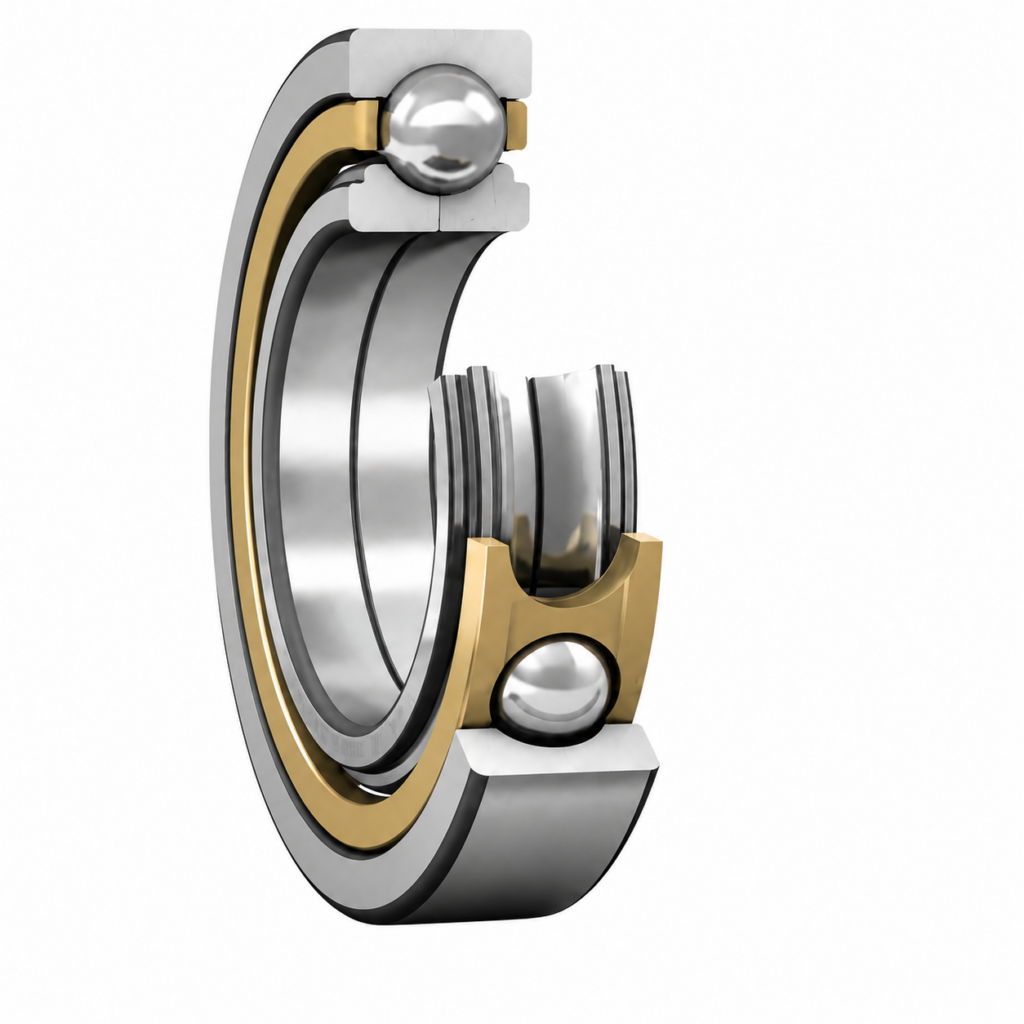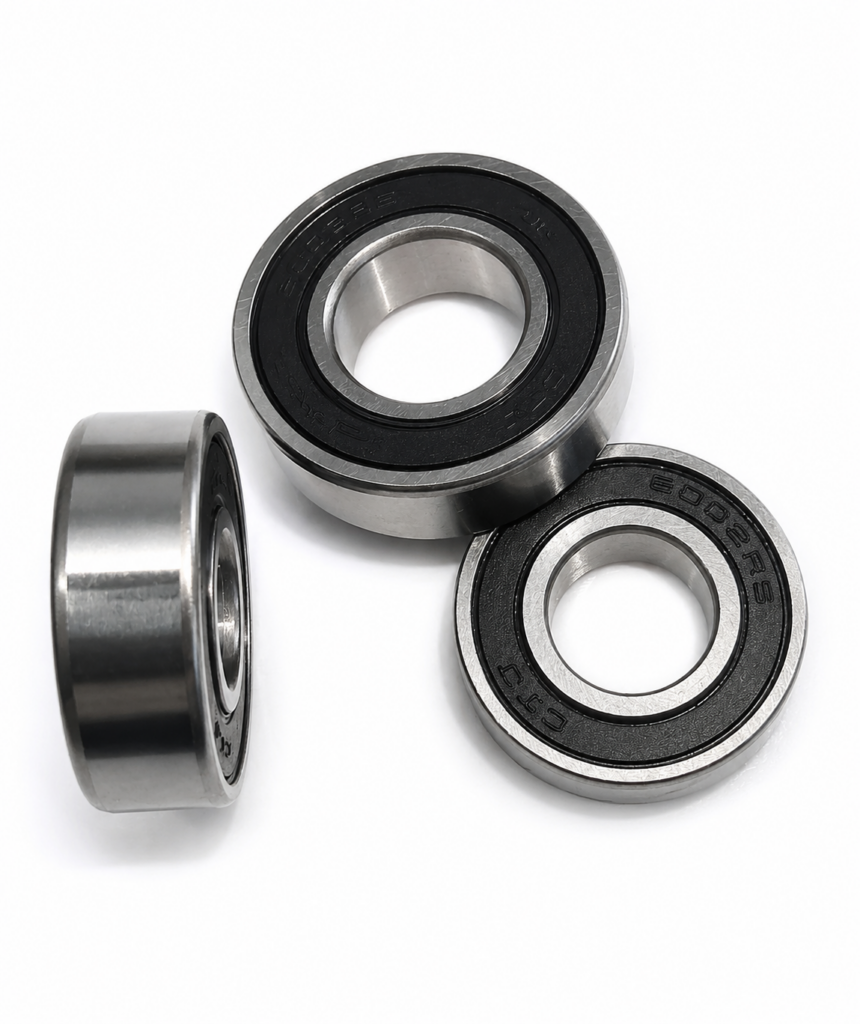
A deep groove ball bearing should not be selected by dimensions alone. Bearings with the same bore, outside diameter, and width may have different internal designs and load ratings, which directly affect their calculated service life.
For an application under pure radial load, the main catalogue values are the basic dynamic load rating C and the basic static load rating C₀. The first is used to calculate rolling fatigue life; the second is used to check whether a heavy or stationary load may cause permanent deformation. Neither value should be interpreted simply as the maximum operating load.
1. Dynamic Load Rating and L10 Life
The basic dynamic load rating C is a reference value representing the constant load under which a bearing achieves a basic rating life of one million revolutions. It does not mean that the bearing should normally operate at that load.
Bearing fatigue life is expressed statistically. The basic rating life L10 is the life that 90% of a sufficiently large group of identical bearings are expected to reach or exceed before fatigue flaking occurs.
L10 = (C / P)³
L10 is expressed in millions of revolutions. For the pure radial-load condition discussed here, the equivalent dynamic load P equals the radial load Fr, so the formula becomes:
L10 = (C / Fr)³
To convert the result into operating hours, use L10h = (1,000,000 × L10) / (60 × n), where n is the bearing speed in revolutions per minute. The third-power relationship is important: bearing life does not decrease in direct proportion to load. A relatively small increase in radial load can cause a much larger reduction in calculated fatigue life.
2. Calculation Example
Consider a deep groove ball bearing with a basic dynamic load rating of 14 kN, operating at 1,500 r/min under a constant radial load. The 14 kN value is used only to demonstrate the calculation and does not refer to a particular bearing model.
| Radial load Fr | Increase | L10 | L10h at 1,500 r/min | Life reduction |
| 2.8 kN | Baseline | 125 million rev | 1,389 h | — |
| 3.5 kN | 25% | 64 million rev | 711 h | About 49% |
| 4.2 kN | 50% | About 37 million rev | 412 h | About 70% |
At 2.8 kN, the ratio C/Fr is 5, giving a calculated life of 125 million revolutions. Raising the load to 3.5 kN represents an increase of 25%, but the calculated life falls to 64 million revolutions. At 4.2 kN, the load is 50% above the original value, while the calculated life falls by approximately 70%.
This is why an inaccurate load estimate can lead to an unsuitable bearing selection. Belt tension, rotor weight, imbalance, process forces, and short-duration overloads should not be ignored simply because they are absent from the normal running-load figure.
3. Static Load Capacity
The basic static load rating C₀ addresses the risk of permanent deformation at the contact between the balls and raceways. It becomes particularly important when the bearing is stationary under load, rotates very slowly, or experiences shock and peak loads.
Under pure radial loading, the equivalent static load P₀ equals Fr. Static safety can therefore be expressed as:
s₀ = C₀ / P₀
The required static safety factor depends on the operating conditions. Bearings used in low-noise or high-precision equipment normally require greater protection from permanent indentation than bearings used in less sensitive machinery. Dynamic and static ratings are therefore not interchangeable. A bearing may satisfy the calculated fatigue-life requirement but still be unsuitable if its static safety margin is too low.
4. Why Calculated Life and Actual Life Differ
The L10 result describes rolling fatigue life under defined assumptions. It is not a guarantee of actual operating hours. In service, many bearings are replaced because of lubrication failure, contamination, corrosion, incorrect fits, inadequate internal clearance, excessive temperature, misalignment, or installation damage rather than normal rolling fatigue.
The load value itself also needs careful attention. If the calculation includes only the normal running load but ignores belt tension, start-up forces, vibration, or intermittent overload, the resulting life can be overly optimistic.
Internal clearance is another common source of error. Shaft interference, housing fit, and the temperature difference between the inner and outer rings can all change the clearance after installation. Insufficient operating clearance increases friction and temperature, while excessive clearance can affect load distribution, vibration, and running accuracy.
A practical selection should therefore combine the L10 calculation with checks of static safety, lubrication, sealing, contamination, fits, operating clearance, temperature, shaft alignment, and housing accuracy.
5. Conclusion
For a deep groove ball bearing under pure radial load, the key fatigue-life relationship is L10 = (C / Fr)³. Because load is raised to the third power, even a moderate increase in radial load can remove a large part of the calculated bearing life. In the example above, a 25% increase in load reduced calculated life by about 49%, while a 50% increase reduced it by about 70%.
The basic dynamic load rating C should be used for fatigue-life calculations, while the basic static load rating C₀ should be used to evaluate permanent-deformation risk. Reliable selection depends not only on catalogue ratings but also on an accurate load estimate and realistic operating conditions.