Introduction
Four-point contact ball bearings are among the most frequently confused bearing types at the procurement stage. They share a similar appearance with angular contact ball bearings, both handle axial loads, and their model designations follow comparable naming conventions — yet their load-handling mechanisms and suitable applications are fundamentally different. Selecting the wrong type rarely causes an immediate, obvious failure. The bearing installs without issue and runs normally at first, but under real operating conditions the service life falls well short of expectations. By the time failure occurs, unplanned downtime has already taken its toll.
This article is written for procurement professionals. It covers what four-point contact ball bearings are, where they belong, how to read their model numbers, and what parameters to verify before placing an order.
1. What Is a Four-Point Contact Ball Bearing?
Basic Structure
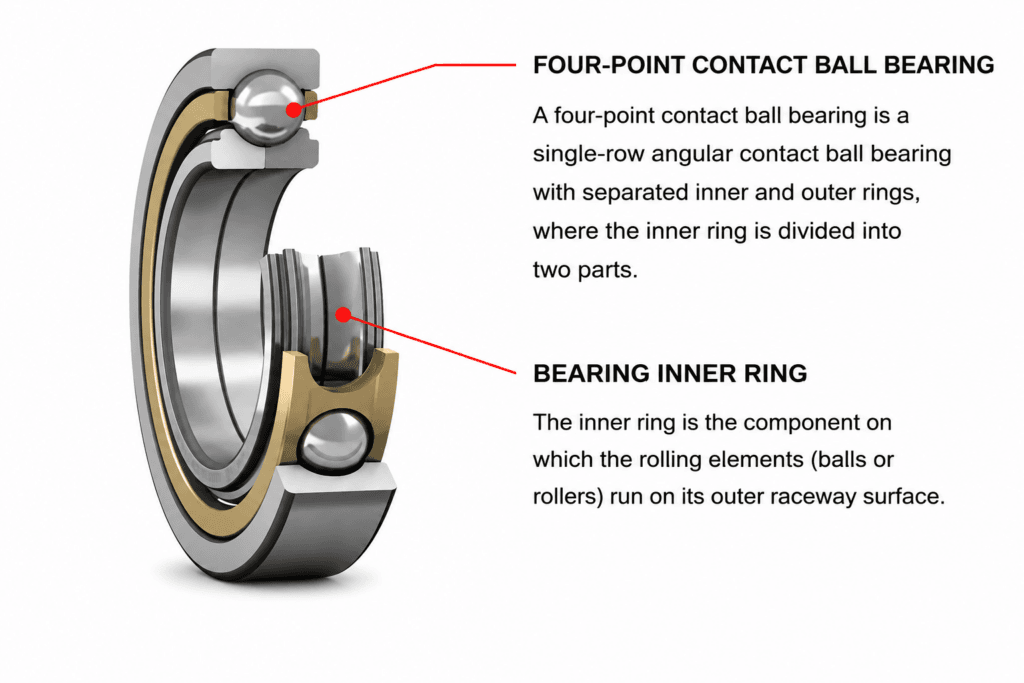
A four-point contact ball bearing consists of an inner ring, an outer ring, steel balls, and a cage — the same four components found in most ball bearing types. The distinguishing feature lies in the raceway geometry. Both the inner and outer ring raceways are machined with a Gothic arch profile, formed by two arcs with different centers. This shape causes each ball to make contact with the inner and outer rings at four points simultaneously — two on each ring — rather than the two contact points found in a standard deep groove ball bearing.
This geometry is what gives four-point contact ball bearings their defining capability: a single bearing that can handle axial loads in both directions at once.
Model Number Identification
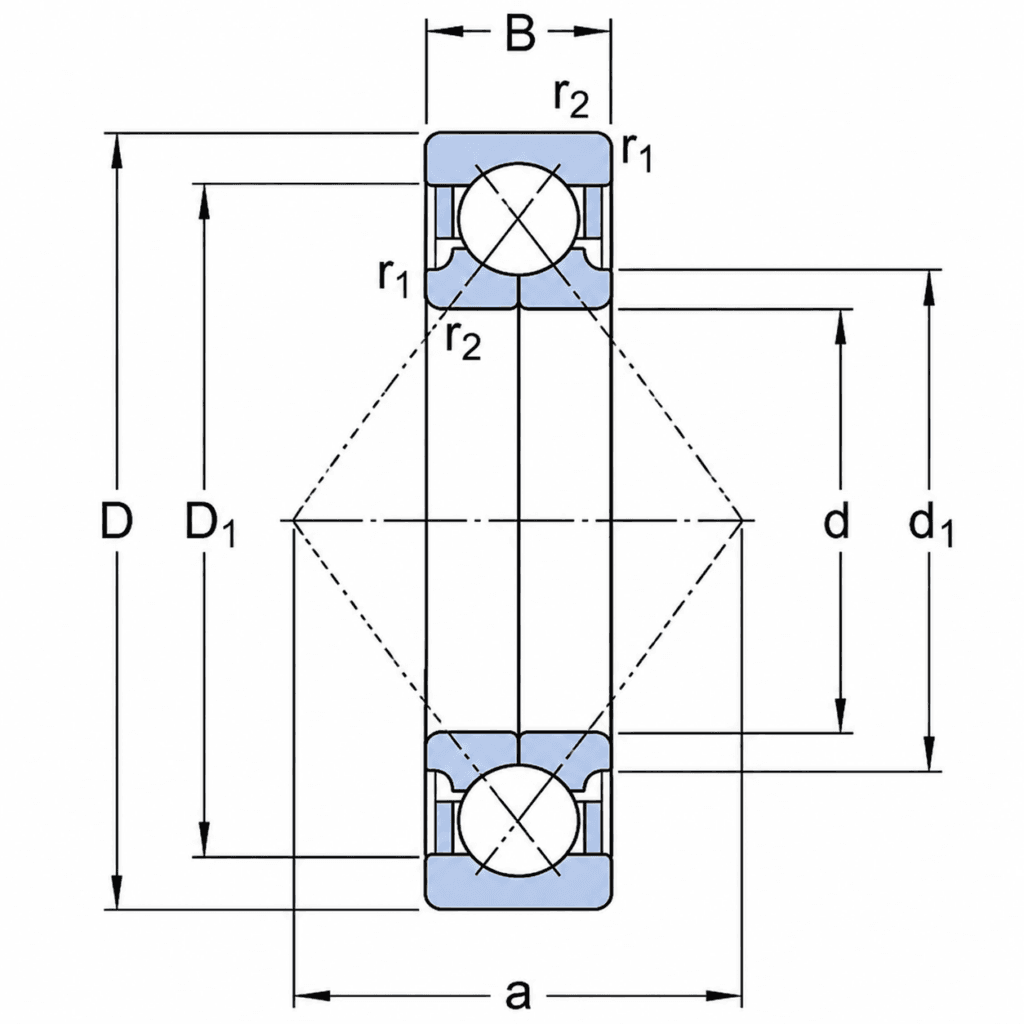
Four-point contact ball bearings use the prefix QJ across international standards. Taking QJ 208 as an example:
- QJ → Four-point contact ball bearing
- 2 → Dimension series (medium series)
- 08 → Bore diameter 40 mm (08 × 5 = 40)
At the procurement stage, confirming the QJ prefix is the fastest way to distinguish this bearing type from others. Angular contact ball bearings use the prefix 7 (for example, 7208). The two are not interchangeable, and a prefix check takes seconds.
2. Load Capacity: What It Handles and What It Does Not
Core Advantage: Bidirectional Axial Load in a Single Bearing
The defining strength of a four-point contact ball bearing is its ability to carry axial loads in both directions within a single unit. In applications requiring bidirectional axial location, one four-point contact bearing can replace a back-to-back or face-to-face pair of angular contact ball bearings, reducing axial space requirements and simplifying shaft assembly.
Limited Radial Load Capacity
The raceway geometry that enables bidirectional axial load handling comes at a cost to radial capacity. A four-point contact ball bearing carries radial loads less effectively than a deep groove ball bearing of equivalent size. Using one in a predominantly radial load application results in both higher cost and shorter service life than a more appropriate bearing type would deliver.
Speed Limitations
Four-point contact ball bearings are not suitable for high-speed continuous operation. The four-point contact geometry introduces additional sliding friction between the balls and raceways at elevated speeds, accelerating heat generation and wear. The permissible speed limit varies by size and manufacturer — always cross-reference the actual operating speed against the bearing manufacturer’s published speed ratings before confirming a selection.
Not Suited for Pure Radial Load Applications
Where the working load is predominantly radial with little or no axial component, deep groove ball bearings or cylindrical roller bearings offer better performance at lower cost. Four-point contact bearings should not be treated as a general-purpose upgrade.
3. Typical Applications
Four-point contact ball bearings appear consistently in applications sharing the same profile: axial loads dominating, installation space constrained, operating speed moderate to low.
Aerospace Accessory Drives
Accessory gearboxes and control system shafts in aircraft engines must handle complex bidirectional axial forces within tightly limited envelopes. Four-point contact ball bearings are a standard choice in these assemblies, valued for their compact footprint and bidirectional load capacity.
Industrial Rotary Tables and Indexing Mechanisms
CNC rotary tables and indexing plates generate bidirectional axial forces and overturning moments during operation. A single four-point contact bearing can manage both load types simultaneously, simplifying the shaft arrangement compared to a paired angular contact solution.
Wind Turbine Pitch Systems
Auxiliary drive positions within wind turbine pitch control systems operate in confined spaces while experiencing bidirectional axial loading. This is one of the more common industrial applications for four-point contact ball bearings in large-scale equipment.
Machine Tool Automatic Tool Changers
Tool changer mechanisms experience frequent load direction reversals during operation and require reliable bidirectional axial load capacity within strict axial dimensional limits. Four-point contact bearings are well suited to this combination of requirements.
4. Four-Point Contact vs. Angular Contact Ball Bearings
The most common procurement confusion involves mixing up QJ series and 7 series (angular contact) bearings. The essential difference comes down to one point:
- Angular contact ball bearings carry axial load in one direction only. Handling bidirectional axial loads requires a matched pair installed back-to-back or face-to-face.
- Four-point contact ball bearings handle axial loads in both directions within a single bearing unit.
If the original equipment uses two angular contact bearings in a back-to-back arrangement, substituting a single four-point contact bearing is not a straightforward swap. Load distribution and mounting dimensions both need to be verified against the original design before any substitution is considered.
From a model number standpoint: prefix 7 indicates angular contact, prefix QJ indicates four-point contact. Checking the prefix at procurement is the most direct method of confirmation.
5. Procurement Checklist
Before confirming a four-point contact ball bearing order, verify the following:
Load Direction
Does the application involve axial loads in both directions? If axial loading is single-directional, an angular contact ball bearing is likely the more appropriate choice.
Operating Speed
Is the actual operating speed within the manufacturer’s published speed limit for the selected bearing? High-speed continuous operation will cause a four-point contact bearing to overheat and fail prematurely.
Model Prefix
Confirm the model number begins with QJ. If the drawing or equipment manual specifies a different prefix, do not substitute without engineering confirmation.
Single or Paired Installation
Most applications use a single bearing. Some heavy-load arrangements require paired installation. Follow the original design specification rather than assuming single-unit installation is always correct.
Sealing and Lubrication
Confirm the required seal configuration — open, single-sealed, or double-sealed — and the appropriate grease specification for the operating temperature and environment.
6. Common Procurement Mistakes
“It handles axial loads, so four-point contact must work here.”
This reasoning ignores speed limitations. A four-point contact bearing placed in a high-speed continuous application will fail from excessive heat well ahead of its rated life. Multiple bearing types can handle axial loads — speed range must be confirmed before type selection is finalized.
Confusing QJ series with 7 series
The two types look similar, share overlapping dimensional ranges, but differ fundamentally in how they carry loads. Matching bore, outer diameter, and width does not make two bearings interchangeable. Always check the model prefix, not just the dimensions.
Assuming one four-point contact bearing always replaces a paired angular contact arrangement
A four-point contact bearing does handle bidirectional axial loads, but its load capacity and stiffness characteristics differ from a matched angular contact pair. Direct dimensional substitution without verifying the original load parameters risks an underspecified installation.
7. Radial Internal Clearance
Like other ball bearing types, four-point contact ball bearings are available in different internal clearance classes. The same principles that apply to deep groove ball bearing clearance selection apply here: interference fits consume clearance, elevated operating temperatures compress clearance, and high-speed applications benefit from slightly greater initial clearance to maintain adequate working clearance after thermal expansion.
If the application involves a significant interference fit or sustained elevated temperature, confirm the clearance class with the bearing manufacturer rather than accepting a standard supply clearance without review.
Conclusion
The core value of a four-point contact ball bearing is straightforward: bidirectional axial load handling in a single compact unit. Its boundaries are equally clear — moderate to low speed, axially dominated loading, and space-constrained installations.
Three checks at procurement will prevent the most common selection errors:
- Does the model number begin with QJ?
- Is the operating speed within the published limit?
- Does the application genuinely require bidirectional axial load capacity?
Confirm these three points, and the selection will be on solid ground.
Reference standards: ISO 15, GB/T 294 Four-point contact ball bearings, GB/T 296 Angular contact ball bearings