
Application
Office Equipment
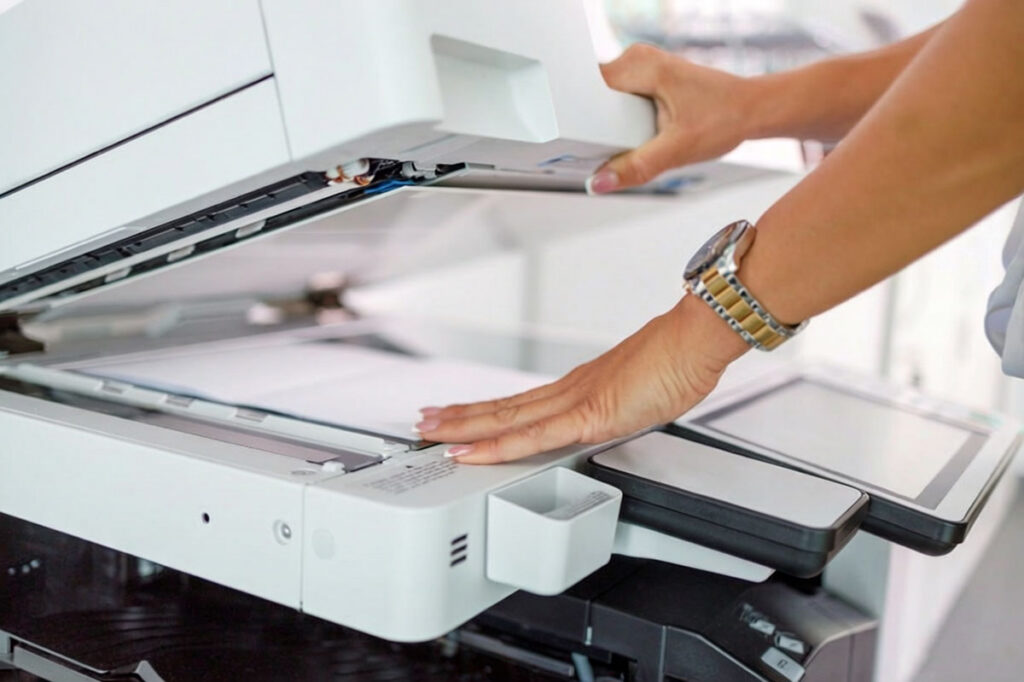
Office equipment operates in an environment that seems unremarkable but imposes its own precise demands. A laser printer cycling through thousands of pages, a scanner processing continuous paper feeds, a shredder running unattended, a projector spinning its color wheel at tens of thousands of RPM — these machines must deliver consistent output quietly and without interruption across years of daily use.
A bearing failure here is not catastrophic, but it is disruptive. A printer that jams, a scanner producing uneven images, a shredder seizing mid-run — each stalls productivity and erodes confidence in the equipment.
The bearing requirements reflect this: low noise and vibration, compact size, long maintenance-free life, and reliable performance across continuous duty cycles. Raw load capacity matters far less than smoothness and longevity under light, repetitive use.
Office equipment spans laser and inkjet printers, photocopiers, scanners, shredders, projectors, and binding machines, each placing different demands on its bearing positions. Deep groove ball bearings, needle roller bearings, and linear bearings cover the majority of applications, each suited to a distinct set of requirements.
Products
Deep Groove Ball Bearings
The standard choice across the rotating assemblies of office equipment. Deep groove ball bearings appear throughout printer motors, copier drum drives, fan assemblies, fuser roller supports, and small gearbox outputs — wherever a shaft must rotate smoothly under light to moderate radial load. Their compact envelope, low friction, and quiet running characteristics make them the natural fit for equipment where noise generation directly affects the working environment.
In office applications, pre-lubricated and sealed variants are standard, as the assemblies are inaccessible during normal service and expected to run maintenance-free for the product lifetime. Miniature and small cross-section series bearings are particularly common, accommodating the space constraints of modern compact equipment designs without compromising rotational smoothness.
Needle Roller Bearings
Where space is severely constrained but load capacity cannot be sacrificed — paper feed roller assemblies in high-volume printers, fuser unit drive trains, gear clusters in photocopier transmissions — needle roller bearings provide the radial load capacity of a much larger bearing within a cross-section that a ball bearing of equivalent capacity could not achieve.
The paper handling mechanisms in modern office equipment are densely packaged, and the roller shafts that transport, turn, and register paper sheets must be supported in bearings that impose minimal radial space penalty. Needle roller bearings meet this requirement directly, carrying meaningful loads within assemblies where even a few millimeters of additional diameter would create design conflicts.
Linear Bearings
Office equipment does not only rotate. Scanner carriage assemblies travel back and forth along precision guide rails thousands of times per day. Inkjet print heads traverse the width of a page on every print cycle. Binding machine punches and folders follow controlled linear paths to produce consistent results. Linear bearings — whether recirculating ball type on hardened rails or plain sleeve type on ground shafts — provide the low-friction, repeatable linear motion that these assemblies require.
In document scanners particularly, the smoothness and consistency of the carriage bearing directly determines image quality: any irregularity in linear motion translates immediately into visible distortion in the scanned output. Linear bearings in office equipment must combine precision guidance with quiet operation, as vibration and noise generated at the bearing level propagate directly into the surrounding structure and the working environment beyond it.
FAQs
What loads can deep groove ball bearings handle?
Deep groove ball bearings are primarily designed for radial loads, but they can also handle moderate axial (thrust) loads in both directions. They are not suitable for heavy axial loads or combined shock loads. In those cases, angular contact or tapered roller bearings are preferred.
How do I select the right bearing size for my application?
Selection should be based on bore diameter (shaft size), required load capacity (dynamic rating C and static rating C0), operating speed compared with the bearing limiting speed, available space (outer diameter and width), and required precision grade from P0 to P2. Always apply a safety factor and verify that the calculated L10 service life meets your requirements.
What is the difference between open, shielded (ZZ), and sealed (2RS) bearings?
Open: No built-in protection, requires external sealing, and is suitable for clean environments or oil bath lubrication.
ZZ metal shields: Protect against dust and debris with low friction, making them suitable for high-speed applications, but they are not waterproof.
2RS rubber seals: Provide strong protection against dust and moisture. They are pre-greased and ideal for contaminated environments, but generate slightly more friction.
How often should I lubricate or replace the grease?
For general industrial use, grease should be replenished or replaced every 3,000 to 10,000 operating hours depending on speed, temperature, and environmental conditions. Bearings running above 70 C or in contaminated environments require shorter intervals. Sealed 2RS bearings are pre-greased for life and do not require re-lubrication.
What are the common causes of premature bearing failure?
The most frequent causes include inadequate or improper lubrication, contamination by dirt, dust, or moisture, incorrect installation, misalignment, excessive force during fitting, overloading beyond the rated capacity, improper shaft or housing fits, and fatigue at the end of normal service life.
How is the rated service life (L10) of a bearing calculated?
The basic L10 life is calculated as L10 = (C / P)^3 x 10^6 revolutions, where C is the dynamic load rating in kN and P is the equivalent dynamic bearing load in kN. It represents the number of revolutions that 90% of identical bearings will complete without fatigue failure. In practice, ISO 281 modified life calculations also apply correction factors for lubrication, contamination, material, and reliability.
Get a Fast Response from Our Team
Share your bearing requirements or project details — our team will review your inquiry and respond with the right product recommendations and pricing.
ETERNUM MOTION TECHNOLOGY