
Application
Automotive
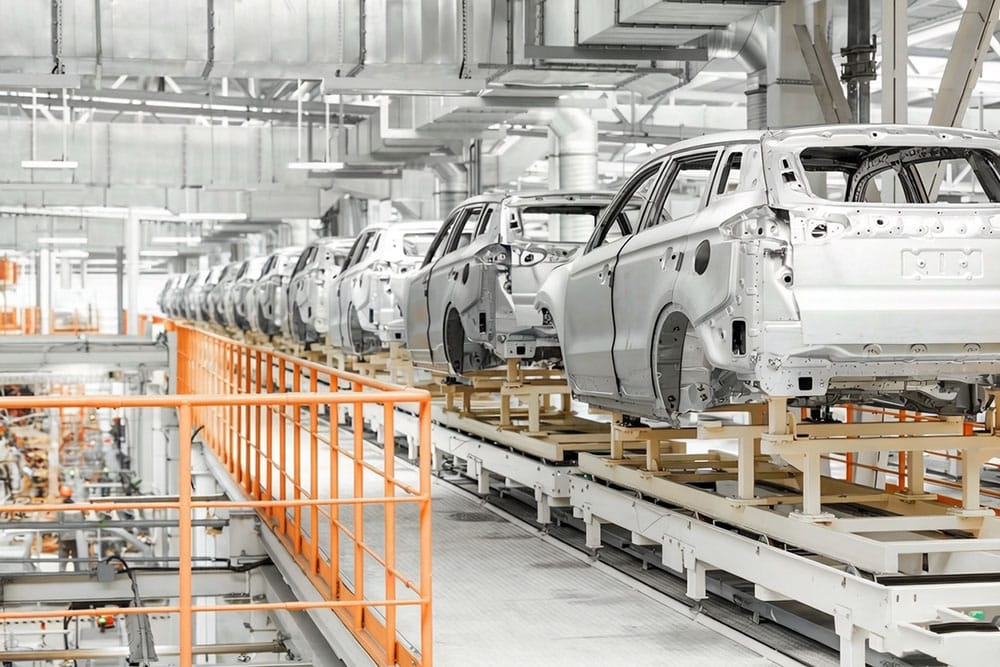
Modern vehicles are assemblies of precisely coordinated motion. From the moment an engine fires to the final rotation of a wheel, every transfer of power — through the crankshaft, transmission, driveshaft, and wheel hub — depends on bearings performing reliably under continuous mechanical stress.
The bearing’s role in an automobile is to support rotating and reciprocating components, reduce frictional losses, and maintain positional accuracy under combined radial and axial loads. In an automotive environment, this means operating across an exceptional range of conditions: cold starts at low lubrication, sustained highway speeds, cornering forces, road-induced vibration, and decades of cumulative cycling. A bearing failure anywhere in the drivetrain does not stay isolated — it propagates. Noise becomes vibration, vibration becomes misalignment, misalignment accelerates wear across adjacent components. Bearing selection and quality directly affect fuel efficiency, NVH performance, and the long-term reliability that determines a vehicle’s reputation.
Automotive applications span a wide range of operating conditions and load profiles. No single bearing type covers the full picture. Deep groove ball bearings, tapered roller bearings, angular contact ball bearings, and needle roller bearings each address specific positions within the vehicle — often working in combination within the same assembly.
Products
Deep Groove Ball Bearings
The most broadly applied bearing type in automotive design. Deep groove ball bearings appear throughout the vehicle’s electrical and auxiliary systems — alternators, water pumps, idler pulleys, tensioner assemblies, electric window motors, seat adjustment mechanisms, and HVAC blower units. Their low torque characteristics make them well suited to the continuous, moderate-load duty cycles of these systems, while sealed variants eliminate the need for periodic relubrication in inaccessible locations. As vehicle electrification advances, deep groove ball bearings are increasingly specified in EV traction motors and ancillary drive units where smooth, low-friction rotation directly affects range efficiency.
Tapered Roller Bearings
Where load capacity and durability define the requirement — wheel hubs, final drive assemblies, transmission shafts, and differential pinions — tapered roller bearings are the standard solution. Their geometry allows simultaneous handling of heavy radial and axial loads, and they can be adjusted during assembly to achieve the precise preload required for each application. In wheel hub units, tapered roller bearings manage the full weight of the vehicle combined with the lateral forces generated during cornering, braking, and road irregularities. The ability to replace inner and outer components independently also provides a serviceability advantage in high-wear positions.
Angular Contact Ball Bearings
In applications where rotational speed and axial precision are prioritized alongside radial load capacity — transmission input shafts, turbocharger assemblies, and higher-performance wheel bearing units — angular contact ball bearings provide a capable alternative to tapered rollers. Their design accommodates combined loading while maintaining shaft positioning accuracy at elevated speeds. In turbocharged engines, where bearing operating temperatures and shaft speeds present particular challenges, angular contact bearings engineered for these conditions are a common specification.
Needle Roller Bearings
Space is always at a premium in handheld tool design. Needle roller bearings deliver high radial load capacity within an exceptionally small cross-section, making them the preferred solution for gearboxes inside hammer drills, reciprocating saws, and impact wrenches — wherever torque must be transmitted within a confined housing. Their ability to handle shock and oscillating loads also suits the intermittent, high-force nature of impact and hammering mechanisms.
Get a Fast Response from Our Team
Share your bearing requirements or project details — our team will review your inquiry and respond with the right product recommendations and pricing.
ETERNUM MOTION TECHNOLOGY
Send an Inquiry
FAQs
What loads can deep groove ball bearings handle?
Deep groove ball bearings are primarily designed for radial loads, but they can also handle moderate axial (thrust) loads in both directions. They are not suitable for heavy axial loads or combined shock loads. In those cases, angular contact or tapered roller bearings are preferred.
How do I select the right bearing size for my application?
Selection should be based on bore diameter (shaft size), required load capacity (dynamic rating C and static rating C0), operating speed compared with the bearing limiting speed, available space (outer diameter and width), and required precision grade from P0 to P2. Always apply a safety factor and verify that the calculated L10 service life meets your requirements.
What is the difference between open, shielded (ZZ), and sealed (2RS) bearings?
Open: No built-in protection, requires external sealing, and is suitable for clean environments or oil bath lubrication.
ZZ metal shields: Protect against dust and debris with low friction, making them suitable for high-speed applications, but they are not waterproof.
2RS rubber seals: Provide strong protection against dust and moisture. They are pre-greased and ideal for contaminated environments, but generate slightly more friction.
How often should I lubricate or replace the grease?
For general industrial use, grease should be replenished or replaced every 3,000 to 10,000 operating hours depending on speed, temperature, and environmental conditions. Bearings running above 70 C or in contaminated environments require shorter intervals. Sealed 2RS bearings are pre-greased for life and do not require re-lubrication.
What are the common causes of premature bearing failure?
The most frequent causes include inadequate or improper lubrication, contamination by dirt, dust, or moisture, incorrect installation, misalignment, excessive force during fitting, overloading beyond the rated capacity, improper shaft or housing fits, and fatigue at the end of normal service life.
How is the rated service life (L10) of a bearing calculated?
The basic L10 life is calculated as L10 = (C / P)^3 x 10^6 revolutions, where C is the dynamic load rating in kN and P is the equivalent dynamic bearing load in kN. It represents the number of revolutions that 90% of identical bearings will complete without fatigue failure. In practice, ISO 281 modified life calculations also apply correction factors for lubrication, contamination, material, and reliability.