Introduction
Bearing clearance is one of the most frequently overlooked parameters in bearing selection. Unlike bore diameter or load rating, it carries no obvious consequence at the point of purchase — the wrong clearance looks identical to the right one, fits the same shaft, and installs without issue. The problem only surfaces later, as unexplained temperature rise, shortened service life, or premature failure.
This article focuses on internal radial clearance in deep groove ball bearings — what it is, how the two most common classes C0 and C3 differ in practice, and how to select the right one for a given application.
What is a Deep Groove Ball Bearing?
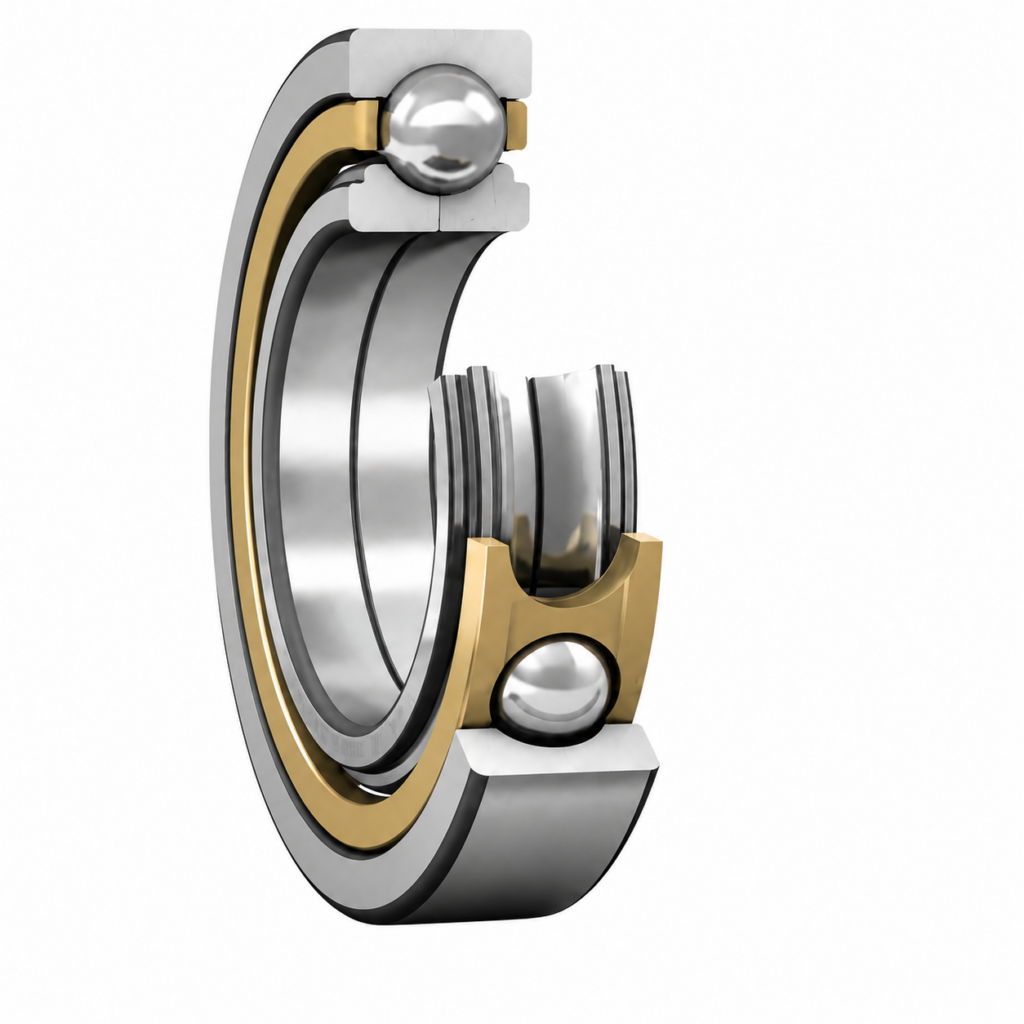
Deep groove ball bearings are the most widely used bearing type globally, accounting for over 80 percent of total bearing sales. Their structure is straightforward, consisting of four essential components: an inner ring, an outer ring, steel balls, and a cage. Featuring deep raceway grooves, they can handle radial loads and a certain degree of axial loads simultaneously. Their scope of application is incredibly vast, found in everything from small motors in household appliances to transmission shafts in heavy industrial machinery.
The nomenclature of deep groove ball bearings follows ISO standards. Common series include the 6200, 6300, and 6000 series, where the numbers in the model designation correspond to the bore size. Take 6208-2RS-C3 as an example, which can be broken down as follows:
- 62: 6200 Series (Light Series)
- 08: Bore diameter of 40 mm (08 multiplied by 5 equals 40)
- 2RS: Rubber seals on both sides
- C3: Clearance class (Greater than Normal)
The suffix C3 at the very end is the core focus of this article, which is the clearance class. Many engineers overlook this parameter during procurement. As a result, bearings experience abnormal temperatures or shortened lifespans after installation, only for troubleshooting and rework to reveal that the wrong clearance was selected.
What is Bearing Clearance?
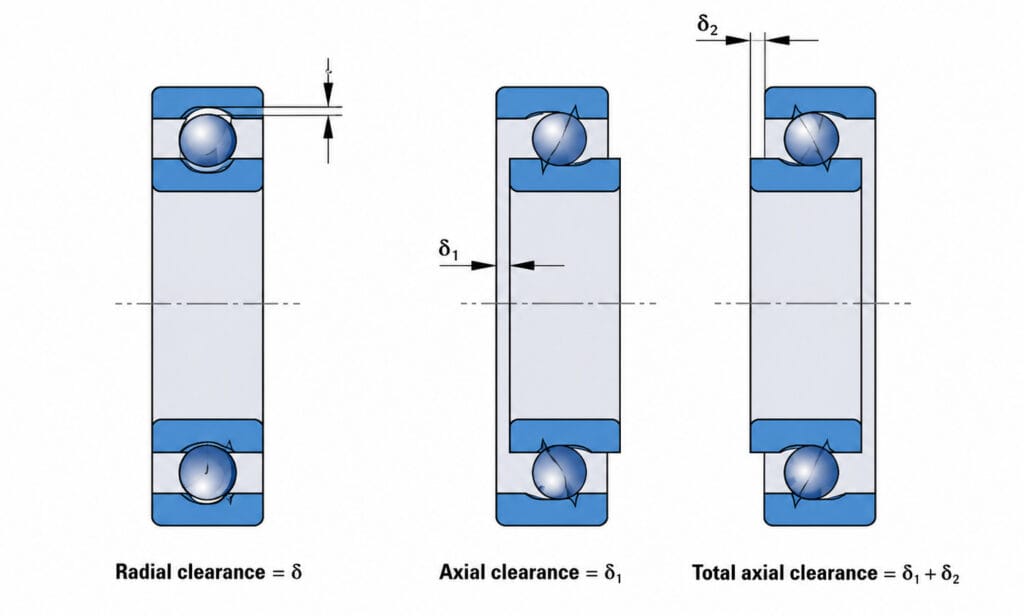
Bearing clearance refers to the maximum distance that the inner ring can move relative to the outer ring when the bearing is uninstalled and free of any load. It is categorized into radial clearance and axial clearance, with radial clearance being the primary consideration during selection.
Clearance directly impacts the following key factors:
- Operating Temperature: Insufficient clearance leads to increased contact stress between rolling elements and raceways, which triggers spikes in frictional heat.
- Noise and Vibration: Excessive clearance allows rolling elements to make micro-impacts within the raceways, resulting in amplified operating noise.
- Load Distribution: Clearance determines the number of rolling elements simultaneously sharing the load, which in turn affects the bearing fatigue life.
- Rotational Accuracy: The smaller the clearance, the smaller the radial runout of the shaft, leading to higher positioning accuracy.
ISO and GB standards classify the radial clearance of deep groove ball bearings into five distinct classes: C2 is less than C0 (CN), which is less than C3, which is less than C4, which is less than C5. Clearance increases sequentially.
In daily engineering selection, C0 and C3 cover more than 90 percent of all working conditions and are the two most critical classes to understand thoroughly.
C0 (CN) Clearance: Normal Clearance
C0 is the factory default specification. Any deep groove ball bearing purchased without a specified clearance suffix is a C0 bearing. Because deep groove ball bearings naturally feature deep raceways, they can handle both radial and axial forces efficiently under standard clearance, making C0 perform exceptionally well in light-load, high-precision applications.
Typical Application Scenarios
- Indoor AC Fan MotorsThe fan of an indoor air conditioning unit rotates at approximately 800 to 1200 rpm, where the shaft-to-bearing fit is either a clearance fit or a very light interference fit, and the operating temperature remains close to room temperature. The low-friction characteristics of deep groove ball bearings combined with the tight clearance of C0 minimize running noise. If replaced with a C3 bearing, the larger clearance causes a slight rattling sound from the rolling elements at low speeds, which becomes highly noticeable in a quiet bedroom.
- Office Equipment (Printer and Copier Feed Rollers)Due to their simple design and cost-effectiveness, deep groove ball bearings are the most common choice inside printers. Feed rollers operate under light loads and low speeds. The tight C0 clearance ensures minimal radial shaft runout, providing more stable feeding accuracy and preventing paper jams or skewing.
- Small Gear Reducers (Output Shafts)The output shafts of small gearboxes run at low speeds (typically below 300 rpm) and are installed using transition fits, resulting in negligible clearance loss. C0 delivers excellent rotational accuracy, which is paramount for automated positioning equipment. Utilizing deep groove ball bearings with C0 clearance satisfies precision requirements while keeping costs under control.
- Medical Auxiliary Equipment (Infusion Pumps, Diagnostic Instruments)Medical devices demand extreme noise control and high precision. The low-vibration properties of deep groove ball bearings paired with a C0 or C2 clearance represent the gold standard for these setups.
C3 Clearance: Loose Clearance, the Workhorse of Industrial Applications
C3 clearance is roughly 25 percent to 50 percent larger than C0. It stands as the most widely implemented clearance class across industrial fields. The inherent structural merits of deep groove ball bearings, namely point contact between the rolling elements and raceway, a low friction coefficient, and a wide speed range, make them uniquely suited to pair with C3 clearance for high-speed, high-temperature, and heavy interference fit installations.
Typical Application Scenarios
- Industrial VFD Electric Motors (The Most Crucial Application)This is the most classic yet frequently botched application for C3. In variable frequency drive (VFD) motors operating at variable speeds, the temperature rise of the shaft is significantly higher than that of the bearing housing, causing the inner ring to thermally expand and compress the clearance. For instance, in a 30 kW 4-pole motor running at full load, the shaft temperature can reach 80 to 90 degrees Celsius. If a C0 bearing is used, thermal expansion completely consumes the clearance, shifting it into a negative clearance state. This triggers a sharp spike in frictional heat, cutting the expected bearing lifespan from 20000 hours down to just a few thousand. Switching to C3 ensures the post-expansion working clearance remains within an optimal range, noticeably lowering running temperatures.The 6200 and 6300 series of deep groove ball bearings serve as the primary choices for motor shafts, and many motor manufacturers specify C3 as standard from the factory.
- Centrifugal Blowers (Large Shaft Diameters, Heavy Interference Fits)Industrial exhaust centrifugal fans typically utilize shaft diameters above 60 mm, with the inner ring and shaft employing a k6 or m6 tight interference tolerance. Post-assembly, the clearance loss can reach up to 30 to 40 micrometers. If a deep groove ball bearing is left with virtually no clearance after mounting, it will face heavy startup torque and rapid temperature spikes. A textile mill once had to replace these bearings every 3 months; after upgrading to a 6312-C3, the lifespan of the exact same bearing model extended past 18 months.
- High-Temperature Drying Equipment (Continuous High-Temperature Environments)The drive shafts of stenter machines in textile mills or drying ovens in food processing plants operate constantly at ambient temperatures of 100 to 150 degrees Celsius. The bearing steel expands under prolonged high heat. If a C0 clearance is used, the internal space will be entirely choked out, leading to a sudden seizure or locking up. The standard engineering practice dictates choosing a deep groove ball bearing with C3 (or even C4) clearance, combined with high-temperature lithium or polyurea grease, to guarantee continuous, uninterrupted operation.
- Industrial Water Pumps (Vertical Multistage Pumps)In vertical pumps, the motor shaft and pump shaft are coupled together, creating a complex mix of axial forces and radial vibrations. Deep groove ball bearings can handle loads from both directions simultaneously. Pairing them with C3 clearance allows the system to easily accommodate heavy interference fits and temperature variations, making it the mainstream solution across the pump industry. Many pump manufacturers explicitly mandate C3 as standard for the motor-end bearing in their selection manuals.
- Metallurgical Auxiliary Drives (Rolling Mills, Conveyor Roller Tables)Auxiliary drive bearings in rolling mills encounter punishing environments defined by heavy shock loads, high temperatures, and intense dust. Deep groove ball bearings are extensively utilized in auxiliary drive locations (as opposed to primary rolling force locations). Equipped with C3 or C4 clearance, and reinforced with labyrinth seals and forced lubrication, they deliver the reliability needed for high-intensity, continuous operations.
Core Comparison: C3 vs. C0
| Parameter | C0 (CN) Normal Clearance | C3 Clearance (Greater than Normal) |
| Clearance Size | Standard baseline | 25 percent to 50 percent larger than C0 |
| Noise Performance | Low; ideal for quiet environments | Slightly higher at low speeds |
| Rotational Accuracy | High | Moderate |
| Temperature Tolerance | Limited; best for room temperature | High; excellent thermal margin |
| Fits and Tolerances | Clearance or light interference fits | Medium to heavy interference fits (such as k6 or m6) |
| Thermal Expansion Margin | Small | Large |
| Load Distribution | More rolling elements share the load | Slightly fewer rolling elements share the load |
| Typical Model Examples | 6204-2RS, 6008 | 6208-2RS-C3, 6312-C3 |
| Target Industries | Appliances, instruments, light industry, precision machinery | Motors, blowers, metallurgy, chemical plants, water pumps |
Engineering Selection Framework
- Step 1: Assess the Shaft Fit and ToleranceIf the inner ring fit is h6 or g6 (clearance or transition fit), C0 is viable. If the fit is k6 or m6 (heavy interference fit), C3 is mandatory.
- Step 2: Evaluate the Operating TemperatureBelow 70 degrees Celsius, C0 or C3 are both acceptable. Above 70 degrees Celsius, C3 is required. Exceeding 120 degrees Celsius, opt for C4 and upgrade to high-temperature grease.
- Step 3: Analyze the Operational SpeedBelow 50 percent of the bearing’s limiting speed, C0 is safe. Exceeding 60 percent of the limiting speed or utilizing variable frequency drive (VFD) regulation, C3 is required.
- Step 4: Review Noise and Precision DemandsHome appliances, medical gear, and precision instruments require C0 or C2. Industrial field environments where noise is secondary require C3.
- Step 5: Determine the Load CharacteristicsPure radial light load requires C0. Shock loads, heavy loads, or dynamic composite loads changing directions require C3.
Common Suffix Misconceptions
- Misconception 1: C3 has a larger clearance, so it must have a higher load capacity.Fact: Incorrect. When clearance is too large, fewer rolling elements simultaneously participate in carrying the load, forcing individual steel balls to bear heavier stress, which accelerates fatigue spalling. The advantage of C3 lies in its thermal adaptability and installation tolerance, not an increased raw load rating.
- Misconception 2: If a C0 bearing fails, simply swap it with a C3.Fact: Sometimes true, sometimes false. If a chemical centrifugal pump fails every three months with a C0 bearing, switching to C3 might solve the issue because a tight interference fit was choking out the clearance. However, swapping to a C3 on a low-speed agitator in the exact same plant might make it significantly louder, because low-speed, light-load setups do not benefit from a larger clearance. You must diagnose the root cause to apply the right fix.
- Misconception 3: When buying OEM replacement parts, clearance code does not matter.Fact: A piece of equipment originally specified an imported 6208-2RS-C3 bearing. During local emergency procurement, the buyer accidentally ordered a standard 6208-2RS (which defaults to C0). After installation, the machinery ran noticeably hot, and hours of teardown diagnostics eventually traced the issue back to the missing C3 designation. Always verify the clearance suffix at the end of the model number before purchasing.
Conclusion
Deep groove ball bearings are the most ubiquitous components in modern machinery, and selecting the correct internal clearance is one of the most critical factors determining whether they survive in the field.
To keep it simple, remember this rule of thumb:
- Room Temperature + Light Load + Precision Priority leads to C0
- High Temperature + High Speed + Interference Fit + Heavy Industrial Load leads to C3
- For general industrial applications where parameters are uncertain, prioritize C3 for its superior fault tolerance.
Choosing the right clearance is the lowest-cost, yet most frequently overlooked step to dramatically extend the service life of your deep groove ball bearings.