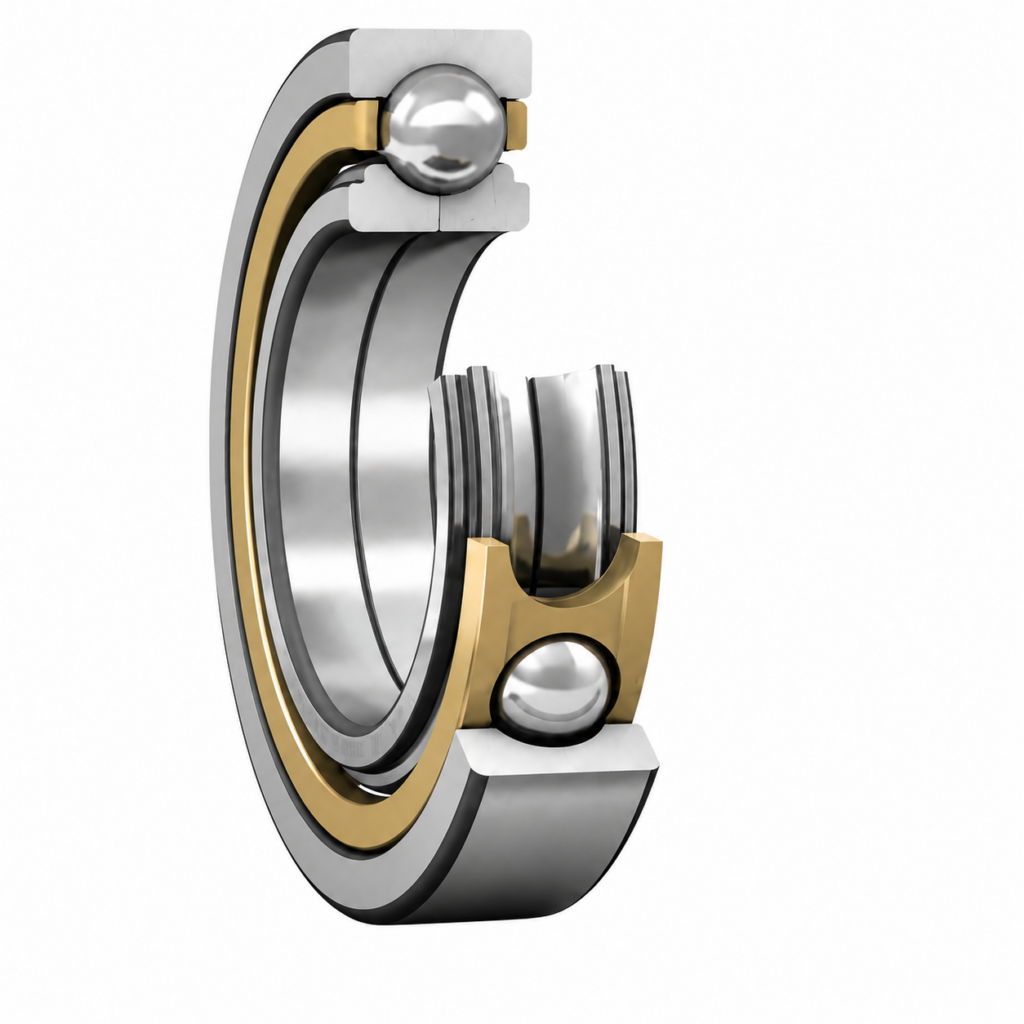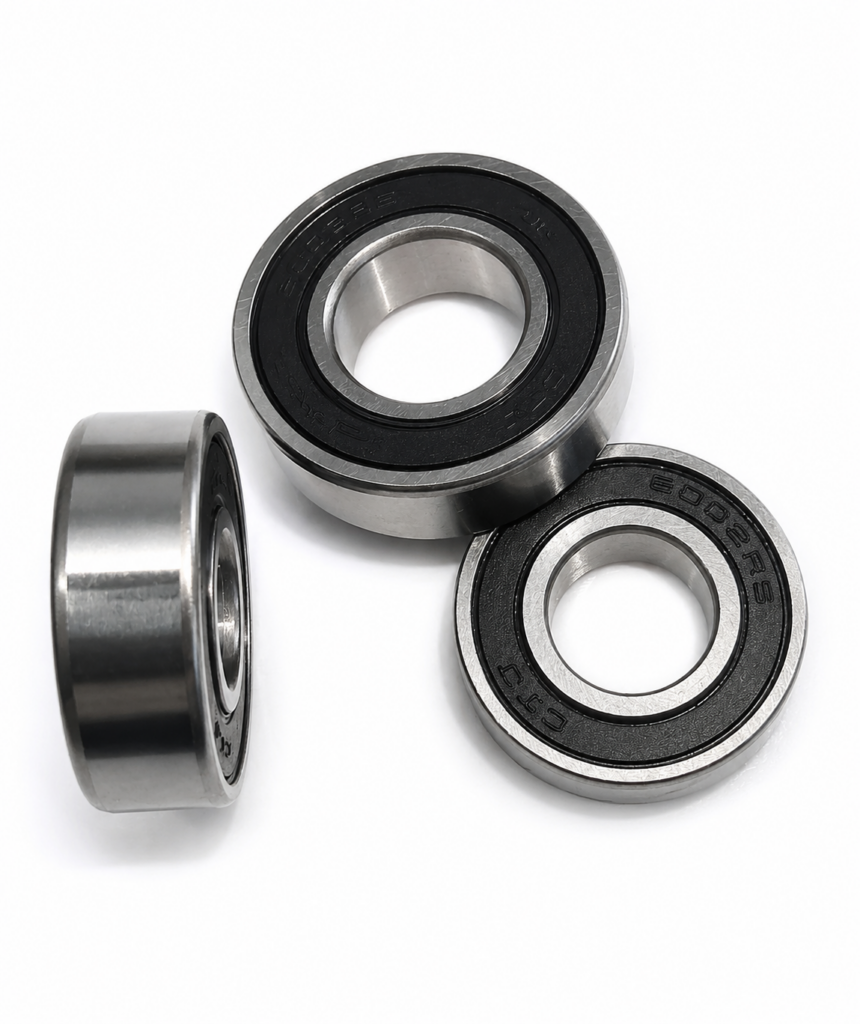
Roller bearings are selected when a machine needs high load capacity, stiffness, compact radial design, misalignment capability, or reliable operation under demanding conditions. Yet “roller bearing” is not one product. Cylindrical, tapered, spherical, needle, and thrust roller bearings behave differently because their rollers, raceways, flanges, contact angles, and internal clearances are designed for different jobs.
This article explains how roller bearings work, compares the main types, and shows how load direction, speed, alignment, available space, lubrication, clearance, and mounting method influence selection. It is intended as a practical overview for equipment designers, maintenance teams, distributors, and industrial buyers who need to identify the right bearing family before checking a specific catalog designation.
1. What Is a Roller Bearing?
A roller bearing is a rolling-element bearing that uses rollers rather than balls to separate moving rings. The rollers may be cylindrical, tapered, barrel-shaped, needle-shaped, or arranged for thrust loading. Because a roller contacts the raceway along a line or an elongated area, it can usually distribute load over a larger contact zone than a similarly sized ball bearing. This is why roller bearings are often selected for heavy radial loads, high stiffness, shock loading, or large shaft diameters.
That advantage does not make every roller bearing suitable for every machine. Roller geometry changes the directions of load that can be carried, sensitivity to misalignment, permissible speed, friction, mounting method, and need for internal clearance or preload. The correct question is therefore not simply whether a roller bearing is stronger than a ball bearing. The useful question is which roller-bearing type matches the load direction, speed, alignment, available space, lubrication, and required service life.
2. Roller Bearings vs. Ball Bearings
Ball bearings use point-like contacts that develop into small elliptical contact areas under load. They generally offer low friction and are widely used at high speeds and under light or moderate loads. Roller bearings use longer contacts and are commonly able to support heavier loads for a comparable envelope, but they may create more friction and heat and can require more careful alignment or minimum loading.
The comparison is not absolute. A high-speed cylindrical roller bearing can outperform many alternatives in the right arrangement, while a poorly aligned cylindrical bearing can suffer edge stress. A spherical roller bearing accepts misalignment but normally has more friction than a deep groove ball bearing. A tapered roller bearing handles combined load well but generates an axial reaction under radial load. Bearing type must be evaluated as part of the entire shaft system rather than chosen from one general rule.
3. Main Types of Roller Bearings
3.1 Cylindrical Roller Bearings
Cylindrical roller bearings use straight cylindrical rollers and are primarily designed for high radial load capacity. Their roller-raceway geometry can also provide high stiffness and good speed capability. Depending on the flange arrangement, designs such as NU and N can allow axial displacement between the shaft and housing inside the bearing, making them useful as non-locating bearings. NJ, NUP, and related designs can locate the shaft axially to different degrees and may carry limited axial load.
Common applications include electric motors, industrial gearboxes, pumps, compressors, machine-tool spindles, generators, and rolling mills. Selection must account for flange configuration, minimum radial load, alignment, cage design, internal clearance, and whether axial thermal expansion must occur inside the bearing.
3.2 Tapered Roller Bearings
Tapered roller bearings have tapered rollers and raceways whose geometry converges toward a common point on the bearing axis. This design supports combined radial and axial loads and provides high stiffness. A single-row tapered roller bearing normally carries axial load in one direction, so it is commonly paired with another bearing in an opposed arrangement. The cup and cone are separable, which simplifies some mounting operations but also makes correct component matching and adjustment important.
These bearings are widely used in vehicle wheel hubs, gearboxes, differentials, construction equipment, agricultural machinery, and industrial shaft systems. Internal clearance or preload must be established correctly. Excessive preload raises torque and temperature, while excessive clearance reduces rigidity and can affect load distribution and gear alignment.
3.3 Spherical Roller Bearings
Spherical roller bearings use two rows of barrel-shaped rollers and a spherical outer-ring raceway. They can carry very heavy radial loads, accept some axial load in both directions, and accommodate angular misalignment caused by shaft deflection or housing error. These properties make them a common choice for severe industrial service.
Typical applications include crushers, vibrating screens, conveyors, paper machines, fans, mining equipment, cement plants, and heavy material-handling systems. Self-alignment is valuable, but it does not correct poor fits, excessive mounting error, an unstable housing, or inadequate lubrication. Vibrating and shock-loaded applications may also require application-specific clearance, cage, and lubrication choices.
3.4 Needle Roller Bearings
Needle roller bearings use long, thin rollers, giving them high radial load capacity relative to their small radial cross-section. They are particularly useful where space between the shaft and housing is limited. Available forms include drawn-cup bearings, machined-ring bearings, needle roller and cage assemblies, combined bearings, and thrust needle roller bearings.
When the shaft acts directly as the inner raceway, its hardness, surface finish, roundness, and dimensional accuracy become part of the bearing system. A compact outside diameter does not remove the need for a high-quality raceway. Automotive transmissions, compressors, power tools, textile machines, small gearboxes, and compact mechanisms are common applications.
3.5 Thrust Roller Bearings
Thrust roller bearings are arranged primarily to carry axial load. Cylindrical and needle thrust bearings provide high axial capacity in a compact arrangement but generally require accurate alignment and are not intended to carry significant radial load. Spherical roller thrust bearings can accommodate heavy axial load, a simultaneous radial component within specified limits, and some misalignment. Tapered roller thrust bearings serve specialized high-thrust applications.
They are used in presses, extruders, crane hooks, vertical shafts, marine systems, machine tools, and heavy gear arrangements. Because different thrust designs have very different radial-load limits and alignment behavior, the full load vector must be checked rather than selecting from axial load alone.
4. Comparison of Roller-Bearing Types
| Type | Primary load | Key strength | Typical applications |
| Cylindrical | Heavy radial; limited axial by design | High radial capacity, stiffness, and good speed | Motors, gearboxes, generators, mills |
| Tapered | Combined radial and axial | High rigidity and adjustable clearance/preload | Wheel hubs, axles, differentials, gear units |
| Spherical | Very heavy radial plus axial | Accommodates misalignment and shaft deflection | Crushers, conveyors, screens, fans |
| Needle | Mainly radial | High capacity with very small radial section | Transmissions, tools, compressors |
| Thrust roller | Mainly axial | High axial capacity; performance depends on subtype | Presses, extruders, vertical shafts |
5. How to Select a Roller Bearing
Start with load direction and magnitude. Pure radial load points toward cylindrical, needle, or spherical roller designs, depending on space, speed, and alignment. Combined radial and axial load often favors tapered roller bearings or certain spherical and flanged cylindrical designs. Predominantly axial load requires a thrust bearing whose permissible radial component is also verified.
Next evaluate speed and heat. Higher speed increases the importance of cage design, lubrication method, accuracy, internal geometry, and heat removal. A catalog limiting speed is not a universal operating target. It assumes particular lubrication and test conditions, and practical limits may be lower because of load, seal friction, temperature, contamination, or insufficient heat dissipation.
Misalignment is another deciding factor. Spherical roller bearings are designed to accommodate angular misalignment, whereas cylindrical and needle designs generally require more accurate alignment. Tapered bearings need accurate adjustment and rigid support. If shaft deflection is expected, the bearing arrangement and housing stiffness should be analyzed rather than assuming a self-aligning bearing can absorb every error.
- Load: direction, magnitude, shock, moments, and duty cycle.
- Speed: continuous speed, acceleration, temperature, and cooling.
- Alignment: shaft deflection, housing accuracy, and permissible misalignment.
- Space: bore, outside diameter, width, and whether a low cross-section is required.
- Location: which bearing locates the shaft and where thermal expansion is released.
- Environment: dust, water, chemicals, electrical current, and maintenance access.
6. Internal Clearance, Preload, Fits, and Shaft Location
Radial internal clearance is the total internal movement available before mounting. An interference fit and the temperature difference between inner and outer rings normally reduce operating clearance. A C3 bearing has greater-than-normal initial clearance; it is not automatically a higher-quality bearing. It is selected when fits, heat, speed, or other conditions would otherwise leave insufficient operating clearance.
Preload is intentional negative clearance used to increase rigidity and control shaft position in suitable arrangements, especially tapered roller bearings. Too much preload increases friction, heat, and risk of early damage. Too little preload or too much end play can reduce accuracy and allow unstable roller loading. Adjustment procedures should follow the bearing and equipment manufacturer’s specification.
The locating bearing fixes the shaft axially, while the non-locating bearing allows thermal expansion. Certain cylindrical roller-bearing designs permit axial displacement internally. In other arrangements, one ring must slide in its seat. If both ends are rigidly located without allowing thermal growth, unwanted axial load and overheating can result.
7. Lubrication, Sealing, and Contamination Control
Lubrication forms a separating film, reduces friction and wear, protects against corrosion, and can remove heat. Grease is convenient for many enclosed arrangements, while circulating oil, oil bath, oil mist, or oil-air systems may be needed for speed, temperature, or heat-removal requirements. Lubricant viscosity must be suitable at operating temperature, not only at room temperature.
Too little lubricant can cause metal contact, wear, and heat. Too much grease can cause churning and temperature rise. Contaminated lubricant can dent raceways and create repeated stress as rollers pass over damaged areas. Effective seals, clean mounting practices, correct relubrication intervals, and clean storage are therefore central to bearing life. In dirty service, better sealing can be more valuable than choosing a bearing with a higher catalog load rating.
8. Installation and Common Failure Causes
Roller bearings require clean, controlled mounting. Force should be applied only to the ring being fitted with interference, and rolling elements should not transmit mounting force. Tapered bores and adapter sleeves require measurement of drive-up, clearance reduction, or another specified mounting parameter. Separable components must be kept as matched sets where required, and bearing seats should be checked for diameter, roundness, taper, shoulder condition, and surface damage.
Common causes of early failure include incorrect fits, insufficient or excessive clearance, excessive preload, misalignment, contamination, unsuitable lubricant, overload, false brinelling during transport, electrical current, and incorrect mounting force. Noise, temperature, vibration, and lubricant condition should be considered together. Replacing a damaged bearing without correcting the system cause often leads to repeat failure at the same location.
9. Common Applications
Roller bearings are used wherever load, stiffness, compactness, or alignment conditions exceed what a standard ball bearing arrangement can efficiently provide. Cylindrical roller bearings are common in motors, generators, gearboxes, compressors, and rolling mills. Tapered roller bearings are widely used in wheel ends, axles, differentials, and industrial gear units. Spherical roller bearings serve crushers, conveyors, screens, fans, and heavy processing machines. Needle roller bearings fit transmissions, tools, compressors, and compact mechanisms. Thrust roller bearings support presses, extruders, vertical shafts, and heavy axial-load systems.
Application labels are only a starting point. Two gearboxes may need different bearings because their speeds, gear forces, shaft stiffness, lubrication, temperature, and duty cycles differ. Reliable selection depends on actual operating data and the complete bearing arrangement.
10. Frequently Asked Questions
What are the main types of roller bearings?
The main industrial categories are cylindrical, tapered, spherical, needle, and thrust roller bearings. Each category has further designs for different load directions, speeds, spaces, and mounting arrangements.
Can roller bearings carry more load than ball bearings?
Roller bearings generally support heavier loads than similarly sized ball bearings because of their larger contact area, but the actual capacity depends on bearing type, size, material, internal design, speed, lubrication, and load direction.
Which roller bearing handles misalignment?
Spherical roller bearings are designed to accommodate angular misalignment. Other roller-bearing types normally require more accurate alignment unless a special design or arrangement provides compensation.
Which roller bearing is best for combined radial and axial load?
Tapered roller bearings are a common choice for combined loads. Certain spherical and cylindrical designs can also carry combined loads, but their axial capacity and arrangement limitations must be checked.
What does C3 mean on a roller bearing?
C3 indicates radial internal clearance greater than normal before mounting. It is selected to achieve suitable operating clearance after the effects of fits and temperature, not as a universal quality upgrade.
Why do roller bearings need a minimum load?
A minimum load helps the rollers maintain stable rolling motion. If the load is too light, skidding or smearing may occur, especially at high speed or with rapid acceleration.
Can one roller bearing replace another type with the same dimensions?
Matching bore, outside diameter, and width is not enough. Load direction, internal geometry, speed, clearance, separability, shaft location, lubrication, and mounting arrangement must also be compatible.
Conclusion
Roller bearings use different roller geometries to solve different load and arrangement problems. Cylindrical designs emphasize radial capacity and stiffness; tapered designs handle combined load and allow adjustment; spherical designs accommodate heavy load and misalignment; needle designs save radial space; and thrust designs carry axial load. Reliable selection requires more than choosing a type name or matching dimensions. The complete operating load, speed, temperature, fits, clearance or preload, lubrication, contamination, shaft location, and mounting process must be considered together. Providing these conditions to the supplier is the most effective way to obtain a roller bearing that delivers the required performance and service life.