When engineers compare a four-point contact bearing vs. angular contact bearings, the QJ design is often described as two bearings in one. That description is useful, but it can also be misleading. One QJ bearing can carry axial load in both directions and occupy substantially less axial space than two single-row angular contact bearings. It does not automatically reproduce the radial capacity, moment stiffness, preload flexibility, speed behavior, or load distribution of every matched pair.
The correct question is not whether one bearing can physically fit where two bearings were used. The real question is whether the complete bearing arrangement still satisfies the actual radial and axial loads, shaft-location requirement, rigidity, speed, lubrication, thermal growth, mounting, and service-life targets.
| Short answer: Yes, one four-point contact bearing can replace two angular contact bearings in selected axial-dominant applications. It should not be treated as a universal one-for-two dimensional substitution. |
1. How the Two Arrangements Work
1.1 Four-Point Contact Ball Bearing
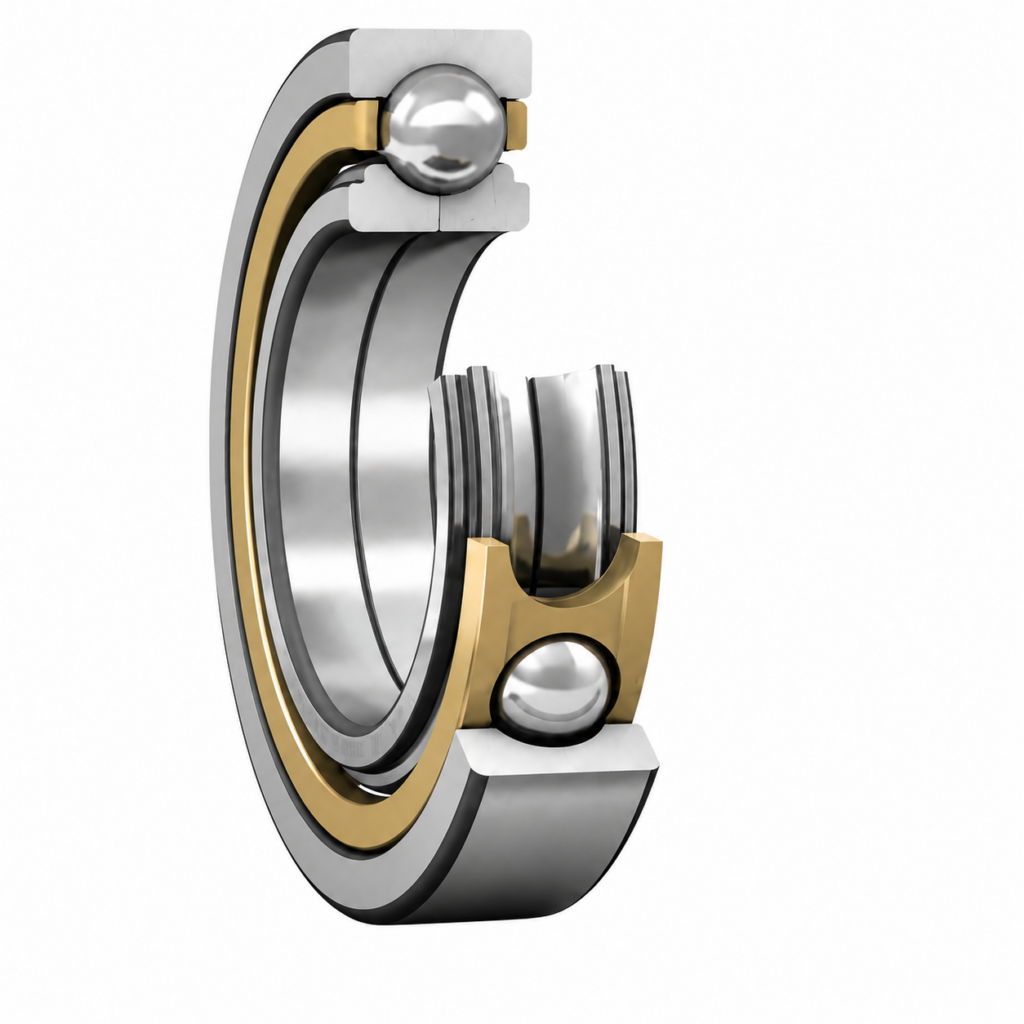
A standard QJ four-point contact ball bearing is a single-row angular contact design with raceway geometry that provides four possible contact locations. Many common designs use a one-piece outer ring, a split inner ring, a large ball complement, and an outer-ring-guided cage. The split inner ring makes assembly possible while allowing more balls and high raceway shoulders to support substantial axial load.
Under a predominantly axial load, the load is normally transmitted through two diagonally opposed contact points. When radial load becomes too large relative to axial load, additional contacts may become active. That can increase friction, heat, sliding, and wear. For this reason, four-point contact bearings are usually strongest as bidirectional axial locating bearings rather than as general-purpose radial bearings.
1.2 Two Single-Row Angular Contact Bearings
A single-row angular contact ball bearing carries axial load mainly in one direction. Two bearings are therefore arranged back-to-back, face-to-face, or sometimes in another matched configuration when the shaft must be supported axially in both directions. The pair can be selected with a defined axial clearance or preload, and the spacing between the bearings can contribute to moment stiffness.
A matched pair gives the designer more freedom to balance radial capacity, axial capacity, rigidity, accuracy, speed, preload, and overturning-moment resistance. That flexibility is one reason paired angular contact bearings remain common in pumps, machine tools, precision shafts, and heavily combined-load arrangements.
2. When Can One QJ Bearing Replace Two Angular Contact Bearings?
The replacement is most credible when the original pair is used mainly to locate the shaft and carry axial load in either direction. The following conditions point toward a four-point contact solution:
- Axial load acts in both directions and clearly dominates the radial load at the bearing position.
- Axial installation space is limited and shortening the bearing arrangement has real design value.
- A separate radial bearing, such as a cylindrical roller bearing, already carries most or all of the radial load.
- The required axial stiffness and shaft-location accuracy can be achieved with the available QJ clearance or preload class.
- The selected QJ bearing meets the required dynamic and static ratings at the real duty cycle and temperature.
- The housing and shaft can provide the fits, shoulders, clamping, and anti-rotation features required by the manufacturer.
For the cited 35-degree QJ designs, SKF recommends Fa/Fr > 1.27 to maintain favorable two-point contact. That value is a useful engineering example, not a universal rule for every brand or design. Contact angle, internal geometry, clearance, speed, and cage construction vary, so the current manufacturer catalog must control the final calculation.
3. Side-by-Side Comparison
| Selection factor | Four-point contact (QJ) | Paired single-row angular contact | Double-row angular contact |
| Bidirectional axial load | Yes, in one bearing | Yes, with opposed pair | Yes |
| Axial space | Very compact | Largest of the three | Compact |
| Radial load | Limited; axial-dominant duty preferred | Strong combined-load flexibility | Good combined-load capability |
| Moment stiffness | Limited as a single narrow bearing | High potential, especially back-to-back and spaced | Moderate to high by design |
| Preload/clearance options | Available but less arrangement flexibility | Wide choice through matching and arrangement | Factory-defined design options |
| Speed | Design-dependent; some QJ designs are highly competitive | Wide high-speed and precision options | Design-dependent |
| Assembly | Split ring halves must stay matched and be clamped correctly | Pair orientation and matching must be controlled | Usually simpler as one unit |
| Best fit | Compact bidirectional axial location | High rigidity, moments, precision, combined loads | Compact general combined-load support |
4. Main Advantages of the Four-Point Contact Bearing
4.1 One Bearing Carries Axial Load in Both Directions
This is the defining functional advantage. A QJ bearing can locate a shaft against axial movement in either direction without using two separate single-row angular contact bearings. In gearboxes, compressors, pumps, traction drives, and other compact systems, that can simplify the axial locating position.
4.2 Shorter and Lighter Bearing Arrangement
Replacing a pair with one bearing can reduce axial envelope, housing length, spacers, shoulders, and related parts. The benefit is not simply a narrower bearing. A shorter shaft span may also simplify the surrounding structure, although the entire shaft and housing still require a stiffness check.
4.3 Large Ball Complement and High Axial Capacity
The split-ring construction permits a large number of balls. Together with high raceway shoulders and a substantial contact angle, this can provide high axial load capacity for the available width. Capacity must still be compared by actual catalog ratings rather than by bearing type alone.
4.4 Accurate Axial Shaft Location
A QJ bearing can provide close axial guidance when clearance, fits, clamping, and thermal conditions are controlled. This makes it valuable as a dedicated locating bearing while another bearing manages radial load or thermal expansion elsewhere in the arrangement.
5. When the Replacement Is Not Recommended
5.1 Radial Load Is Too High
A four-point contact bearing can carry some combined load, but it should not be selected as though it were a deep groove ball bearing or a general radial bearing. If radial load is significant, the ball-raceway contact pattern can become unfavorable. A separate radial bearing or a different angular contact arrangement may be necessary.
5.2 The Pair Provides Important Moment Stiffness
Two angular contact bearings in a back-to-back arrangement have a wide effective spread between load lines and can resist overturning moments. If the bearings are physically spaced apart, that moment capability can be even more important. One narrow QJ bearing cannot automatically reproduce this geometry.
5.3 Precisely Controlled Preload Is Central to the Machine
Machine-tool spindles and other precision systems may use matched angular contact bearings with defined preload classes and carefully selected arrangements. The objective may be rigidity, runout control, thermal stability, and high-speed behavior rather than only bidirectional axial capacity. In such cases, a one-bearing substitution may sacrifice the design feature that matters most.
5.4 The Application Has Severe Combined or Variable Loads
Shock load, strong radial load, reversing axial load, shaft bending, and rapidly changing speed can create a load history that is not represented by a simple maximum value. Equivalent load, minimum load, static safety, cage load, lubrication, and thermal behavior must be evaluated across the duty cycle.
6. QJ vs. Paired vs. Double-Row: Which Alternative Fits?
- Choose a four-point contact bearing when compact bidirectional axial location is the priority and radial load at that position is low or carried elsewhere.
- Choose a paired single-row angular contact arrangement when high rigidity, moment resistance, configurable preload, precision, or demanding combined loads are the priority.
- Choose a double-row angular contact bearing when one compact unit is preferred but the application needs broader combined-load support than a typical axial-dominant QJ position.
These are screening rules, not final selections. The part-number comparison must include basic dynamic and static ratings, fatigue life, limiting speed, minimum load, contact angle, internal clearance or preload, cage, lubrication, fits, tolerances, and surrounding-part geometry.
7. Application Examples
Industrial Gearbox
A cylindrical roller bearing can carry the main radial gear load while a QJ bearing locates the shaft axially in both directions. In this arrangement the QJ outer ring may require radial freedom in the housing so it does not unintentionally pick up radial load. Anti-rotation and axial clamping details must follow the selected manufacturer’s guidance.
Compressor or Pump
Where pressure forces reverse and axial space is restricted, one QJ bearing may replace an opposed angular contact pair. The engineer must still verify rotor dynamics, radial load, minimum load, lubrication flow, temperature, and the consequences of axial clearance.
Machine-Tool or Precision Spindle
A matched angular contact set is often preferable when preload, stiffness, runout, and moment resistance govern performance. The QJ option should only proceed if calculations and testing show that it meets those precision requirements, not simply because it occupies less space.
8. Mounting Details That Decide Whether the Design Works
- Keep the two split inner-ring halves together as a matched set; do not mix halves from another bearing of the same size.
- Apply mounting force only through the ring being fitted with interference, never through the balls.
- Clamp the split inner-ring halves axially according to the manufacturer specification.
- If another bearing carries radial load, design the QJ housing fit so the QJ does not become unintentionally radially loaded.
- Use locating slots or another approved anti-rotation method when the outer ring requires radial freedom.
- Check operating clearance after interference fits and temperature differences are considered.
- Confirm lubricant type, viscosity, quantity, delivery, and heat removal for the real speed and load.
Mounting recommendations are design-specific. For example, SKF describes a housing arrangement with radial clearance for certain QJ thrust-pack applications, but that detail should not be copied to another design without checking the current catalog and the equipment geometry.
9. Selection Workflow
- Resolve the radial load, axial load in both directions, overturning moment, shock load, and duty cycle at the bearing position.
- Identify whether the existing angular contact pair mainly provides axial location, radial support, moment stiffness, preload, or several functions at once.
- Check whether a separate bearing can carry radial load and provide the required thermal-expansion path.
- Compare candidate QJ, paired single-row, and double-row bearings by catalog ratings, life, speed, minimum load, clearance or preload, and accuracy.
- Design and verify shaft seats, housing seats, shoulders, clamping, anti-rotation, lubrication, and assembly sequence.
- Validate operating temperature, vibration, noise, axial movement, and lubricant condition after installation.
10. Frequently Asked Questions
Can one QJ bearing always replace two angular contact bearings?
No. It can replace the bidirectional axial-locating function in suitable axial-dominant applications, but it may not replace the pair’s radial capacity, moment stiffness, preload flexibility, precision, or spacing effect.
Does a four-point contact bearing always run on four contact points?
No. Under a predominantly axial load, two diagonally opposed contact points normally transmit the load. Four active contacts can indicate that radial load is materially influencing the contact pattern.
Is a four-point contact bearing the same as a double-row angular contact bearing?
No. Both can carry axial load in both directions, but their internal structures, radial capacity, stiffness, contact patterns, width, and mounting behavior differ.
Can a QJ bearing carry radial load?
It can carry radial load within design-specific limits, but most standard selection guidance favors predominantly axial loading. The permitted ratio and equivalent-load calculation must come from the selected manufacturer’s current catalog.
What is the biggest advantage of replacing a pair with one QJ bearing?
The main advantage is compact bidirectional axial location: one bearing can perform the axial locating role in both directions while reducing axial envelope and component count.
Conclusion
One four-point contact ball bearing can replace two single-row angular contact bearings when the job is primarily bidirectional axial location, the radial load is limited or carried by another bearing, and the QJ bearing satisfies life, speed, stiffness, clearance, lubrication, and mounting requirements. Its strongest advantages are compact axial space, high axial capacity for its width, and accurate axial shaft location. The replacement becomes risky when the original pair also provides substantial radial support, moment resistance, controlled preload, precision, or a deliberate spacing effect. Treat the change as an arrangement redesign, not a dimensional substitution, and use current manufacturer data and application calculations