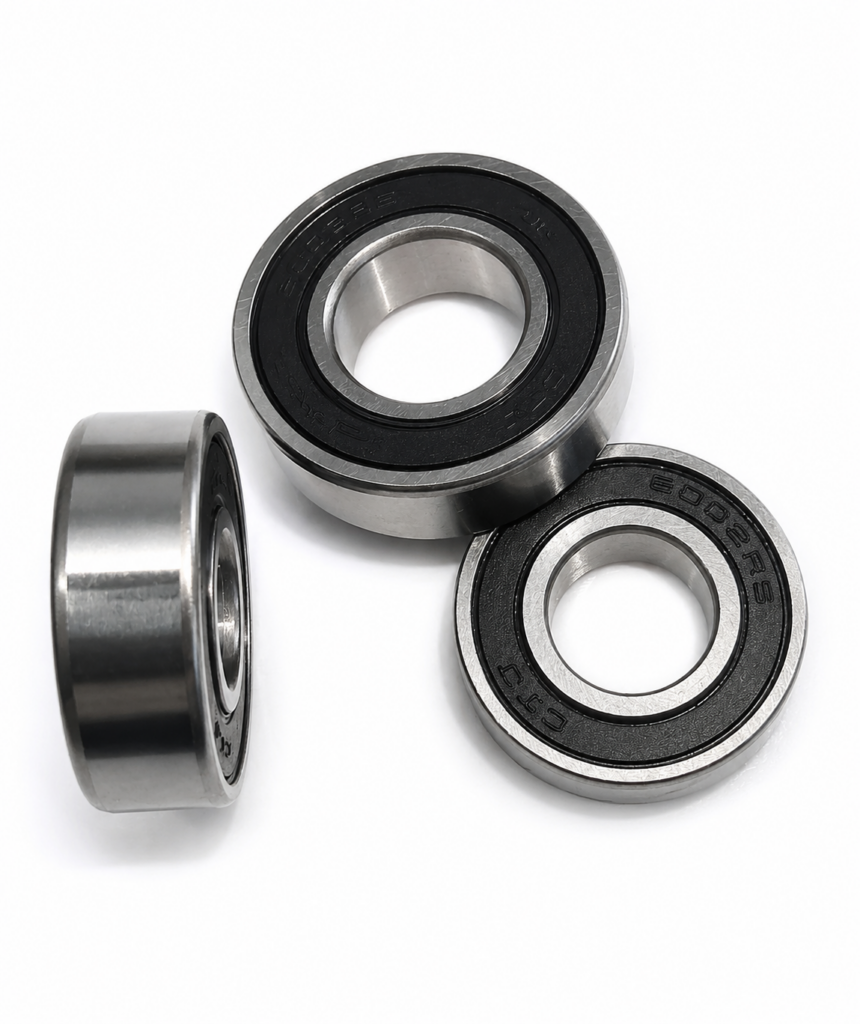
Deep groove ball bearings often look almost identical when viewed separately. The differences become much clearer when several bearings with the same bore diameter are placed side by side. A 6805, 6905, 6005, 6205, 6305 and 6405 can all fit a 25 mm shaft, but their outside diameters range from 37 mm to 80 mm, while their widths increase from 7 mm to 21 mm.
This is an important point for both purchasing and machine design. The bore diameter alone does not define the size or performance of a bearing. Bearings that fit the same shaft may require completely different housings and may offer very different load ratings, stiffness levels, masses and speed capabilities.
The numbers 68, 69, 60, 62, 63 and 64 do not indicate quality grades. They identify different dimension series. NSK’s bearing designation information lists the 68, 69, 60, 62 and 63 series among the principal series for single-row deep groove ball bearings. The heavier 64 series is less common in compact equipment, but manufacturers such as SKF continue to catalogue standard 64-series bearings, including the 6405.
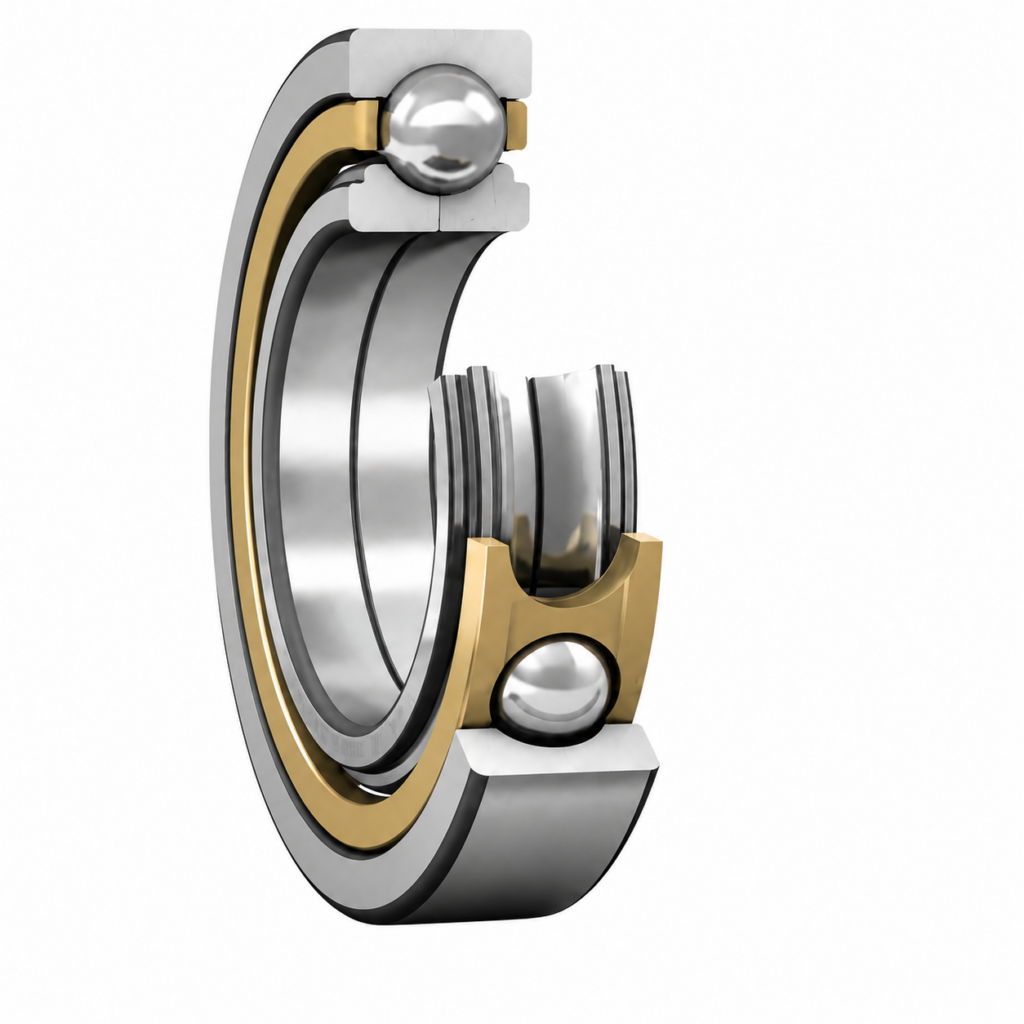
Deep groove ball bearings have relatively deep raceway grooves in both the inner and outer rings. Their geometry allows them to support radial loads and moderate axial loads in either direction. Their simple, non-separable construction, low friction and suitability for relatively high rotational speeds explain why they are widely used in electric motors, pumps, fans, power tools, appliances and general industrial machinery.
How to Read a Designation Such as 6205
The designation 6205 can be divided into three basic parts. The first digit, 6, identifies a single-row deep groove ball bearing. The following digit, 2, identifies the dimension series. The last two digits, 05, form the bore code.
For common metric bearings with bore codes from 04 to 96, the bore code is normally multiplied by five to determine the nominal bore diameter in millimetres. A 6205 therefore has a 25 mm bore. The codes 00, 01, 02 and 03 are exceptions and represent bore diameters of 10, 12, 15 and 17 mm respectively.
The same bore-code rule applies to 6005, 6305 and 6405. Each bearing has a 25 mm bore because each designation ends in 05. What changes is the dimension series ahead of the bore code.
In practical machine design, the shaft diameter usually determines the required bearing bore. The designer then selects the dimension series according to the available housing space, radial load, axial load, stiffness, speed and required operating life. The question is therefore not simply which bearing fits the shaft, but which cross section is appropriate for the complete operating condition.
Comparing Bearings With the Same 25 mm Bore
The boundary dimensions of several common bearings with a 25 mm bore are shown below.
| Bearing | Bore d | Outside Diameter D | Width B | General Position |
|---|---|---|---|---|
| 6805 / 61805 | 25 mm | 37 mm | 7 mm | Extra-thin section |
| 6905 / 61905 | 25 mm | 42 mm | 9 mm | Thin section |
| 6005 | 25 mm | 47 mm | 12 mm | Compact light series |
| 6205 | 25 mm | 52 mm | 15 mm | General-purpose light series |
| 6305 | 25 mm | 62 mm | 17 mm | Larger medium section |
| 6405 | 25 mm | 80 mm | 21 mm | Heavy section |
These dimensions can be checked against official NSK, NTN and SKF product information. Depending on the manufacturer and catalogue convention, the thin series may be written as 6805 and 6905 or as 61805 and 61905. Their corresponding standard boundary dimensions remain 25 × 37 × 7 mm and 25 × 42 × 9 mm.
The contrast between the 6805 and 6405 shows why the dimension series matters. Both bearings fit a 25 mm shaft, but the 6805 has an outside diameter of only 37 mm, whereas the 6405 has an outside diameter of 80 mm. A housing designed for the 6805 cannot accommodate the 6405. Conversely, replacing a 6405 with a 6805 merely because the bore fits would remove most of the cross section and load capacity for which the original arrangement was designed.
The 68 and 69 Series: Saving Space Before Increasing Load Capacity
The 68 series is one of the thinnest commonly available metric deep groove ball bearing series. A 6805 measures only 25 × 37 × 7 mm. The radial section between its bore and outside diameter is just 6 mm. In some international catalogues, the corresponding designation is 61805. SKF, for example, lists the 61805 with the same 25 × 37 × 7 mm boundary dimensions.
The main reason to select this series is space. A compact instrument, encoder, lightweight rotary assembly or small automation mechanism may require a 25 mm shaft for structural stiffness or connection geometry, while leaving very little room around the shaft for the bearing housing. The 68 series makes it possible to retain the shaft diameter without creating a large surrounding structure.
The thin section is not automatically an advantage in every respect. According to NSK’s product data, an open 6805 has a basic dynamic load rating of 4.95 kN, uses balls with a diameter of 3.5 mm and has an approximate mass of only 0.021 kg. The small rolling elements and thin rings are consistent with a bearing intended for compact, relatively light-duty arrangements rather than heavy radial loading.
Housing stiffness and manufacturing accuracy also become more important with a thin bearing. A lightweight ring is more easily affected by an out-of-round housing, excessive interference fit or shaft deflection. Selecting a thin bearing without considering the surrounding components can reduce internal clearance, distort the raceways and shorten operating life.
The 69 series remains compact but provides more cross section. A standard 6905 measures 25 × 42 × 9 mm. It is only 5 mm larger in outside diameter and 2 mm wider than the 6805, but the additional material gives the rings and rolling elements more room. NTN lists the 6905 at 25 × 42 × 9 mm, while SKF catalogues the equivalent boundary dimensions under the 61905 designation.
The difference between the 68 and 69 series is therefore practical. The 68 series gives priority to the smallest possible cross section. The 69 series accepts a modest increase in housing size in exchange for greater structural margin. When the 68 series is too light but a 60 or 62 series bearing is too large, the 69 series can provide a useful intermediate solution.
The 60 and 62 Series: Compact Versus General Purpose
The 60 series has a noticeably larger cross section than the 68 and 69 series, but it remains relatively compact. A 6005 measures 25 × 47 × 12 mm. NSK lists a basic dynamic load rating of 11.1 kN, a ball diameter of 6.35 mm and an approximate bearing mass of 0.079 kg for the open 6005.
A comparison with the 6805 is revealing. Both bearings have the same 25 mm bore, but the ball diameter in the 6005 is almost twice that of the 6805. The dynamic load rating also increases from 4.95 kN to 11.1 kN. This is not the result of a different operating principle; it is the direct result of providing more cross-sectional space for stronger rings and larger rolling elements.
The 60 series is often a sensible choice for compact electric motors, fans, power tools, appliances and other equipment that requires more load capacity than a thin-section bearing can provide but does not justify the larger dimensions of a 62 or 63 series bearing.
It would be inaccurate, however, to describe the 60 series simply as a low-load bearing. When correctly selected, fitted and lubricated, it can operate continuously in many industrial applications. Its limitation is relative: for the same bore diameter, it generally has less ring section and smaller rolling elements than the corresponding 62 or 63 series bearing.
The 62 series is one of the most widely used deep groove ball bearing series. A 6205 measures 25 × 52 × 15 mm. NSK’s open 6205 has a basic dynamic load rating of 15.4 kN, uses balls approximately 7.94 mm in diameter and has a mass of about 0.129 kg.
Compared with the 6005, the 6205 adds only 5 mm to the outside diameter and 3 mm to the width. That increase is moderate from a housing-design perspective, but it creates enough internal space for larger balls and stronger raceway sections. The result is a substantial increase in load capacity and rigidity without moving into the much larger dimensions of the 63 series.
This balance explains why the 62 series is frequently treated as a general-purpose starting point. It is not the smallest, fastest or strongest series. Instead, it offers a practical combination of dimensions, load capacity, availability and cost for motors, pumps, fans, conveyors and general machinery.
“General purpose” should not be interpreted as “suitable without calculation.” A 6205 still needs to be checked against the actual radial and axial loads, speed, temperature, required life, internal clearance, lubrication and contamination level.
The 63 and 64 Series: More Section, More Capacity and More Space
The 63 series has a considerably larger cross section than the 62 series. A 6305 measures 25 × 62 × 17 mm. Its outside diameter is 10 mm larger than that of a 6205 even though both fit the same shaft.
NSK lists a basic dynamic load rating of 22.6 kN for the open 6305. It uses balls approximately 10.32 mm in diameter and has a mass of about 0.235 kg. Compared with the 6005, the bearing is almost three times as heavy, but it provides much larger rolling elements and significantly higher radial load capacity.
The 63 series is therefore considered when a machine requires more radial capacity or stiffness than the 60 or 62 series can provide. Larger electric motors, industrial pumps, belt-driven systems, agricultural machinery and certain gearboxes may benefit from the stronger rings and larger balls.
A 6305 should not be viewed as an upgraded 6205 that is automatically better. If the operating load is modest, the larger bearing may add housing size, rotating mass, friction and cost without producing a useful improvement. At high speeds, larger rolling elements also produce greater centrifugal effects and can contribute to higher operating temperatures.
The 64 series increases the cross section much further. SKF lists the 6405 with dimensions of 25 × 80 × 21 mm and a basic dynamic load rating of 35.8 kN. For a bearing with a 25 mm bore, an 80 mm outside diameter represents a very substantial housing.
This series is appropriate only where the machine genuinely requires a large deep groove ball bearing section and has enough installation space. It is not widely used in compact motors, portable power tools or household appliances.
There is also a point at which a designer may reconsider the bearing type rather than continuing to increase the ball-bearing section. For predominantly heavy radial loads, a cylindrical roller bearing or another roller-bearing design may provide a more appropriate contact geometry. The 64 series is therefore useful for particular applications, but it is not simply the final step in a universal progression.
What the Actual Data Shows
Statements such as “the 60 series is faster” and “the 63 series carries more load” are directionally useful but incomplete. Comparing actual products from the same manufacturer shows the trade-off more clearly.
NSK’s open 6005, 6205 and 6305 all have 25 mm bores. Their basic dynamic load ratings are 11.1, 15.4 and 22.6 kN respectively. Their catalogue speeds under grease lubrication are 18,000, 15,000 and 13,000 r/min. Their ball diameters increase from 6.35 mm to approximately 7.94 mm and 10.32 mm.
This comparison illustrates the normal engineering exchange. A larger cross section permits larger rolling elements and stronger raceways, increasing load capacity and stiffness. At the same time, the bearing becomes heavier, requires a larger housing and may have lower speed capability under comparable catalogue conditions.
The relationship is not perfectly linear. NSK lists the same grease speed of 18,000 r/min for the 6805 and 6005, despite their different sizes. Permissible speed depends not only on the dimension series but also on internal geometry, cage design, lubrication, sealing, clearance and thermal conditions.
The figures should therefore be used to understand the direction of the trade-off, not as a universal rule for every brand or bearing variant. Boundary dimensions may be standardized, while internal geometry, load ratings and speed values can differ among manufacturers.
Dimension Series and Seal Designations Are Separate
The numbers 60, 62 and 63 identify the dimension series. Suffixes such as Z, ZZ, 2Z, RS and 2RS describe shields or seals. These are different parts of the designation and should not be treated as parallel bearing categories.
A plain 6205 normally identifies an open bearing. A 6205-Z has a metal shield on one side, while 6205-ZZ or 6205-2Z normally indicates shields on both sides. Market designations such as RS and 2RS are commonly associated with one or two rubber seals, but the exact suffix system varies by manufacturer.
NSK uses Z and ZZ for one and two shields. Its seal designations include D, DU, DW and V, with doubled forms for seals on both sides. SKF commonly uses suffixes such as 2Z, 2RZ, 2RS1 and 2RSH. A buyer should therefore verify the manufacturer’s definition rather than assuming that similar-looking suffixes always describe the same contact geometry, seal material or friction level.
The seal arrangement also affects operating behaviour. A contact seal normally provides better protection against contamination and moisture but creates more friction than an open bearing or metal shield. Consequently, two bearings with identical boundary dimensions and the same basic series may still have different speed limits and torque characteristics.
Choosing the Appropriate Series in a Real Application
Bearing selection should begin with the machine, not with a list of part numbers. The first step is to define the shaft diameter and the maximum outside diameter and width that the housing can accept.
When radial space is extremely limited, a 68 or 69 series bearing may be considered. When the available space is normal and loads are moderate, the 60 or 62 series often provides a more practical balance. When radial load or stiffness requirements are higher, the 63 series may be appropriate. The 64 series should normally be reserved for designs that genuinely require its large cross section.
The actual bearing load must then be established. It includes more than the weight of the rotor or mounted component. Belt tension, gear forces, axial thrust, rotor unbalance, acceleration, braking and shock loading can all contribute to the forces carried by the bearing. Shaft deflection and housing deformation can also change how the load is distributed among the balls.
Application priorities vary. In an electric motor, noise, vibration, grease life and temperature may be more critical than maximum static capacity. In a pump, continuous operating life, axial load, moisture protection and temperature may dominate the decision. In a power tool, high speed, impact, contamination and frequent starting and stopping may all need to be considered together.
Internal clearance and fits are equally important. An interference fit on the shaft or in the housing reduces the bearing’s remaining internal clearance. Temperature differences between the inner and outer rings can reduce it further. Selecting a larger bearing does not correct an unsuitable fit or insufficient clearance.
The correct series is therefore not necessarily the largest one that fits. It is the smallest practical bearing that can satisfy the required load, speed, life, stiffness, temperature, noise and environmental conditions with an appropriate safety margin.
Conclusion
The 68, 69, 60, 62, 63 and 64 series use the same basic deep groove ball bearing principle, but they provide very different cross sections for the same shaft diameter.
The 68 series prioritizes minimum size and weight. The 69 series remains thin but provides more structural margin. The 60 series combines compact dimensions with useful load capacity and speed performance. The 62 series offers a widely used balance of size, load rating, availability and cost. The 63 series provides larger rolling elements and higher rigidity for more demanding loads. The 64 series offers a very large section for particular heavy-duty arrangements where sufficient housing space is available.
A bearing should not be selected only because its bore fits the shaft, and a larger bearing should not automatically be considered more reliable. The final choice should be based on boundary dimensions, dynamic and static load ratings, speed, internal clearance, seals, lubrication, fits, temperature, contamination and required operating life.