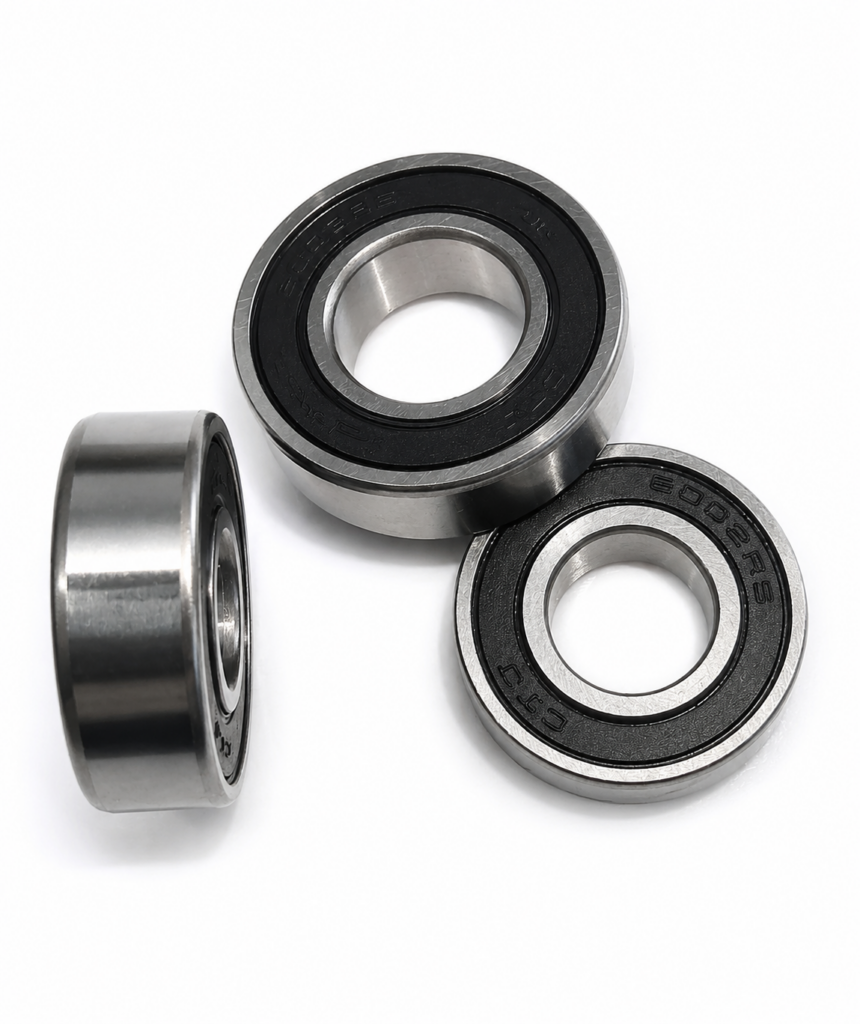
The 608 bearing is one of the most widely recognized small deep groove ball bearings. Its compact 8 mm bore, 22 mm outside diameter, and 7 mm width allow it to fit small motors, rollers, fans, power tools, conveyors, office equipment, 3D printers, skates, and many other light-duty rotating systems. Because the same basic size is sold with different shields, seals, internal clearances, lubricants, materials, and precision levels, however, the number 608 alone is not enough to define the best bearing for every application.
This article explains what a 608 bearing is, how to read the designation, how open, shielded, and sealed versions differ, and which operating details should be confirmed before purchase. The central point is simple: standard 608 bearings share the same basic boundary dimensions, but they do not necessarily deliver the same protection, friction, speed capability, noise level, or service life.
1. What Is a 608 Bearing?
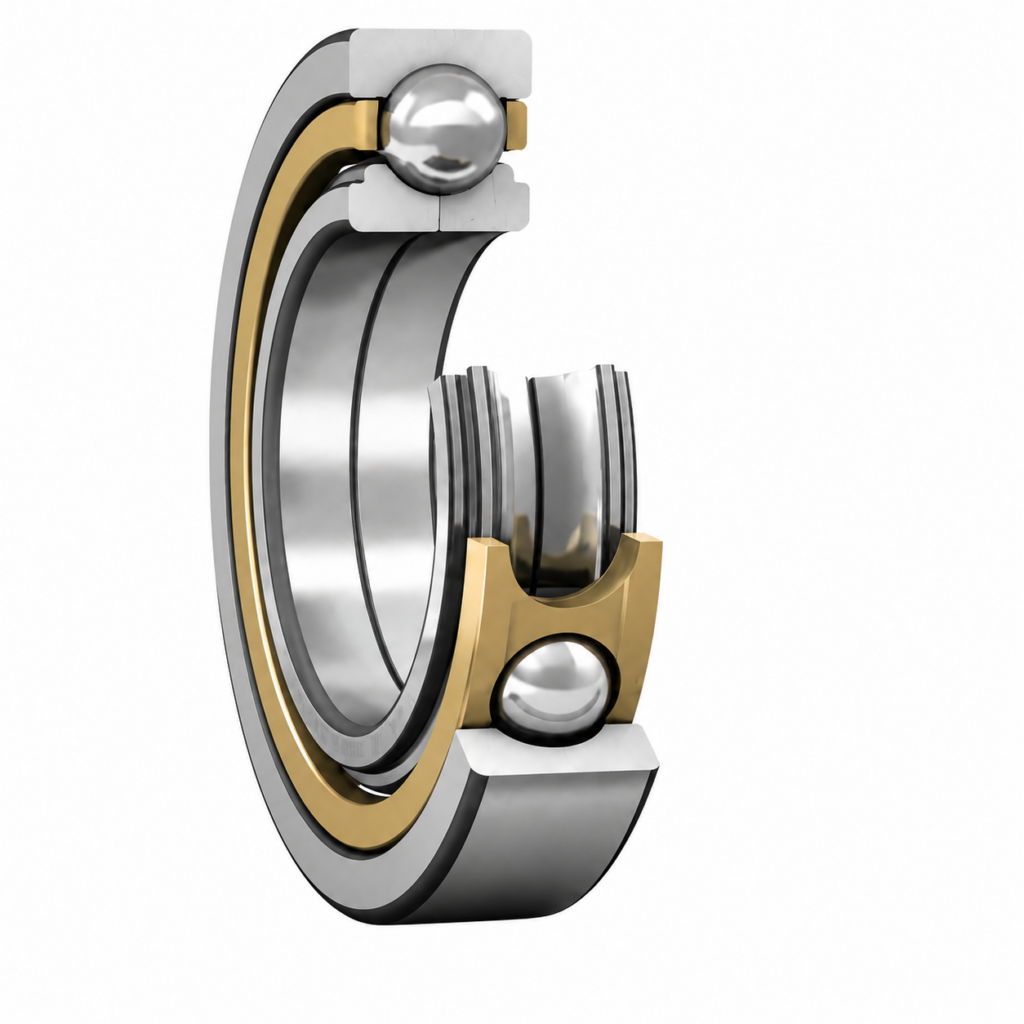
A 608 is a single-row deep groove ball bearing in a compact metric size. It contains an inner ring, an outer ring, balls, a cage, and raceways with deep grooves. This geometry makes the bearing efficient for radial load while also allowing it to support a limited axial load in either direction. It is not a thrust bearing, so applications with dominant or heavy axial load require a different bearing arrangement.
In everyday trade, the expression “608 series” usually refers to the commercial family built around the 608 basic size. That family can include the open 608, metal-shielded 608ZZ or 608-2Z, rubber-sealed 608-2RS or 608-2RSH, C3-clearance versions, stainless-steel versions, hybrid ceramic versions, and flanged products such as F608. These products may look similar, but suffixes and special features can change their performance and interchangeability.
| Parameter | Typical 608 specification |
| Bearing type | Single-row deep groove ball bearing |
| Bore diameter (d) | 8 mm |
| Outside diameter (D) | 22 mm |
| Width (B) | 7 mm |
| Load direction | Primarily radial; limited axial load in both directions |
| Common closures | Open, metal shields, or rubber seals |
2. What Does the Number 608 Mean?
The first digit, 6, identifies the bearing as a single-row deep groove ball bearing. The remaining digits place it in the compact 60 dimensional family and identify the 8 mm bore used by this miniature designation. A common mistake is to apply the normal “last two digits multiplied by five” rule and conclude that 08 means a 40 mm bore. That rule is not applicable to this small 608 designation. A standard 608 bearing has an 8 mm bore.
The number should also not be confused with 6008 or 6080. A 6008 is a much larger bearing with a 40 mm bore, while a 6080 is larger again. When requesting a quotation, it is safer to specify both the complete designation and the dimensions: for example, “608-2RS, 8 × 22 × 7 mm.” This simple check prevents errors caused by missing zeros, spacing, or brand-specific suffixes.
3. 608, 608ZZ, and 608-2RS: What Is the Difference?
The closure is often the most important visible difference between 608 variants. It controls how easily dust and moisture can reach the raceways, how well grease is retained, and how much friction the closure adds. There is no single closure that is best in every machine.
Open 608
An open 608 has no shield or seal on either side. It provides easy access for lubrication and avoids closure friction, but the rolling contacts are exposed. It is appropriate for clean equipment where lubrication and contamination are controlled by the surrounding machine. It is a poor choice for exposed dust, washdown, water spray, or dirty workshop conditions unless the housing provides effective external sealing.
608ZZ or 608-2Z
A shielded version uses metal shields on both sides. The small gap between the shield and the inner ring normally produces low friction while helping retain grease and block larger particles. Shielded 608 bearings are common in small electric motors, fans, rollers, and other relatively clean equipment where speed and low torque matter. A shield is not a waterproof seal; fine contamination and moisture can still enter under unfavorable conditions.
608-2RS or 608-2RSH
A sealed version uses elastomer seals on both sides. Contact seals generally provide better protection against dust and splash and retain grease more effectively than metal shields. The trade-off is additional friction and heat, especially at high speed. Sealed versions are often preferred for dirty environments, outdoor equipment, skates, and mechanisms expected to operate with little maintenance.
Suffix systems are not completely universal. One manufacturer may use ZZ while another uses 2Z for two shields. Double seals may be identified as 2RS, 2RSH, DD, or DDU depending on brand and seal design. The suffix should therefore be checked against the supplier’s technical data rather than interpreted from habit alone.
| Version | Protection | Friction / speed tendency | Best fit |
| 608 open | Lowest | Lowest closure friction; lubrication is exposed | Clean systems with controlled lubrication |
| 608ZZ / 608-2Z | Moderate | Usually lower friction than contact seals | Dry, relatively clean, higher-speed equipment |
| 608-2RS / 608-2RSH | Highest of the three | More sealing friction; grease is retained well | Dust, splash, limited maintenance |
4. How to Select the Right 608 Version
Selection should begin with the operating environment, not with price or appearance. In a clean enclosed motor, a shielded bearing may provide the desired balance of grease retention and low friction. In a dusty roller, a wet application, or equipment that cannot be relubricated, a sealed design may provide longer life. An open bearing may be appropriate when an external lubrication system and housing seals already protect it.
Speed is another key condition. Published limiting or reference speeds depend on the internal design, closure, cage, lubricant, clearance, load, temperature, and manufacturer’s test criteria. A catalog speed for one open 608 should not be copied to every sealed 608. Contact seals and high-viscosity grease can reduce practical speed capability. For a high-speed motor, buyers should provide the required rotational speed, temperature, duty cycle, and noise target so the bearing and grease can be matched as a system.
Load also matters even though the bearing is small. A 608 can carry radial load and limited axial load, but shock, belt tension, misalignment, and an excessive press fit may increase the actual internal stress. Catalog dynamic and static load ratings vary with internal design and material. Buyers comparing brands should use the data sheet for the exact designation rather than assuming every 608 has identical ratings.
- Confirm contamination, moisture, and cleaning exposure.
- State the continuous and maximum rotational speed.
- Define radial load, axial load, shock, and belt or chain tension.
- Confirm operating temperature and duty cycle.
- Specify noise, vibration, starting torque, and service-life expectations.
- Check shaft and housing fits before choosing internal clearance.
5. Internal Clearance, Precision, Lubrication, and Materials
Internal clearance
Normal clearance is suitable for many ordinary applications. C3 indicates greater-than-normal radial internal clearance before mounting. It is not automatically a higher-quality grade. C3 may be necessary when an interference fit, high operating temperature, or a thermal difference between the rings reduces clearance during operation. In a lightly loaded, low-temperature mechanism, unnecessary C3 clearance can increase vibration or noise. The correct choice depends on the installed operating clearance, not the suffix alone.
Precision and ABEC ratings
Precision classes control specified dimensional and running tolerances, but a higher ABEC or equivalent tolerance class does not by itself guarantee longer life. Material cleanliness, raceway finish, cage quality, lubricant, sealing, installation, and load conditions remain critical. A high-precision bearing with unsuitable grease or poor contamination protection can fail earlier than a correctly selected standard-precision bearing.
Lubrication
Many shielded and sealed 608 bearings are supplied greased for life. The grease should match the speed, temperature, load, noise requirement, and compatibility of seals or cage materials. More grease is not always better: excessive fill can increase churning, torque, and temperature. For demanding motor or low-noise applications, grease specification can be as important as the bearing designation.
Materials
Standard bearing steel is common for general industrial use. Stainless-steel variants offer improved corrosion resistance but still require appropriate lubrication and may not match the load capability of every bearing-steel design. Hybrid bearings use ceramic balls with steel rings and can offer electrical insulation or high-speed benefits in specialized applications, but they should not be selected only because “ceramic” sounds superior. Cost, impact loading, fits, lubrication, and failure mode must all be considered.
6. Common Applications of 608 Bearings
The 608 size appears in many products because it is compact, widely available, and economical. Industrial uses include small electric motors, cooling fans, blowers, guide rollers, light conveyors, office machines, printers, instruments, power tools, and compact automation mechanisms. Consumer and recreational uses include skateboards, inline skates, scooters, and small wheels.
The same dimensions do not mean that a skateboard bearing and a motor bearing are functionally identical. A skateboard may prioritize contamination resistance, shock tolerance, and easy replacement. A small motor may prioritize low noise, low torque, grease life, and controlled vibration. A conveyor roller may prioritize sealing and resistance to dust. The application requirements should determine the closure, clearance, lubricant, and precision—not the popularity of a particular retail description.
7. Installation and Maintenance Considerations
Even a correctly selected 608 bearing can fail early if it is installed incorrectly. Mounting force must be applied to the ring with the interference fit. Pressing on the outer ring to install a tight inner ring transmits force through the balls and can dent the raceways. Use a clean, flat mounting tool that contacts the correct ring, keep the bearing square to the shaft or housing, and avoid hammer blows.
Check shaft and housing dimensions with instruments suitable for the required tolerance; a general-purpose caliper is useful for identification but may not be accurate enough for precision fit control. Do not wash factory-greased sealed bearings unless the manufacturer’s process specifically requires it. During operation, investigate increasing noise, temperature, or vibration rather than repeatedly replacing the bearing without correcting contamination, misalignment, overload, or fit problems.
8. Frequently Asked Questions
What size is a 608 bearing?
A standard 608 bearing measures 8 mm bore × 22 mm outside diameter × 7 mm width.
Are all 608 bearings the same?
They normally share the same basic boundary dimensions, but closures, clearance, precision, grease, materials, cage design, load ratings, speed capability, and quality control may differ.
Which is better, 608ZZ or 608-2RS?
Neither is universally better. ZZ or 2Z is often preferred for lower friction in clean, dry conditions; 2RS or an equivalent sealed design is often preferred where contamination and moisture protection are more important.
Can 608ZZ replace 608-2RS?
The dimensions may interchange, but performance may not. Confirm environmental protection, speed, torque, temperature, and maintenance requirements before changing the closure.
What does C3 mean on a 608 bearing?
C3 means the unmounted radial internal clearance is greater than normal. It is used when fits or temperature are expected to reduce operating clearance, not as a universal quality upgrade.
Is a 608 bearing only for skateboards?
No. Skateboards are a visible use, but the same basic size is also common in small motors, fans, rollers, tools, printers, and automation equipment.
Is F608 the same as 608?
F608 is a flanged version. Its main bore and body size may be related to 608, but the flange changes the external geometry and housing interface, so interchangeability must be checked.
Conclusion
A 608 bearing is a compact single-row deep groove ball bearing with standard dimensions of 8 × 22 × 7 mm. The basic size is easy to recognize, but a reliable purchase requires more than matching three dimensions. Closure type, internal clearance, grease, speed, load, temperature, precision, material, fits, and environmental exposure all influence performance. For quotations and replacements, provide the complete designation and operating conditions. That information allows the supplier to recommend a 608 variant that fits both the machine and the expected service life.