
Application
Agricultural Machinery
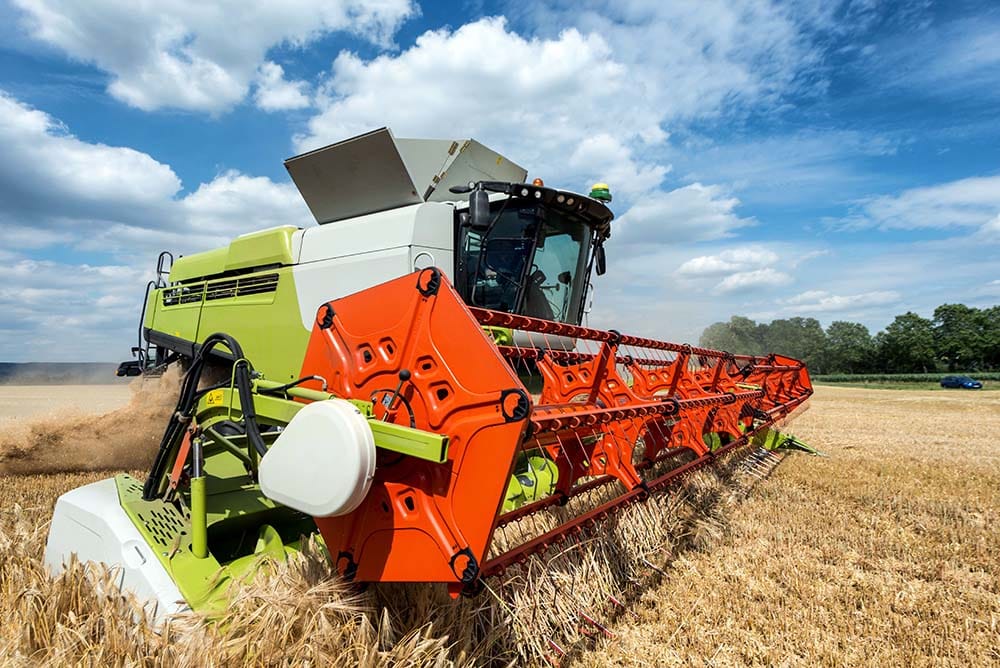
Agricultural machinery operates in some of the most demanding conditions any mechanical equipment can face. A combine harvester working through a wheat field at peak harvest, a seeder covering hundreds of hectares in a single day, a rotary tiller breaking compacted soil – these machines run long hours, in remote locations, through dust, moisture, crop debris, and wide temperature swings. Downtime during a harvest window is not an inconvenience. It is a direct financial loss that cannot be recovered.
The bearing requirements in agricultural machinery reflect this reality. Durability under contamination, resistance to shock and impact loads, the ability to operate for extended periods without attention, and straightforward replaceability in the field – these are the priorities. Performance under laboratory conditions matters far less than performance under field conditions.
Agricultural equipment spans a wide range of machinery – combine harvesters, tractors, seeders, sprayers, rotary tillers, balers, and grain handling equipment – each placing different demands on its bearing positions. Deep groove ball bearings, tapered roller bearings, and spherical roller bearings cover the majority of applications across this equipment, with each type addressing a distinct set of operating requirements.
Products
Deep Groove Ball Bearings
The most widely used bearing type across agricultural machinery. Deep groove ball bearings appear throughout the lighter rotating positions in harvesting and seeding equipment – conveyor shafts, fan assemblies, auger drives, electric motor supports, and small gearbox outputs. Their versatility, availability, and ease of replacement make them the default choice wherever loads are moderate and rotational speed is the primary consideration. In agricultural applications, sealed variants (2RS) are standard rather than optional – field environments offer no practical opportunity for relubrication, and contamination from soil, chaff, and moisture is constant. The 6200 and 6300 series cover the majority of positions across most equipment categories.
Tapered Roller Bearings
Where the combination of radial and axial loads becomes significant – wheel hubs on tractors and trailers, bevel gearboxes in drive axles, harvester header drives – tapered roller bearings provide the load capacity and adjustability that the application demands. Agricultural wheel hubs in particular experience sustained radial loading from vehicle weight combined with axial forces from field terrain and turning. Tapered roller bearings handle this combination reliably, and their adjustable preload allows worn assemblies to be brought back into specification during routine maintenance rather than replaced outright. The 302xx and 303xx series are among the most common specifications across tractor and harvester drivetrain positions.
Spherical Roller Bearings
Agricultural machinery is structurally flexible in ways that industrial equipment is not. Long shafts deflect under load. Frames flex when a machine crosses uneven ground. Mounting surfaces are rarely perfectly aligned after years of field use. Spherical roller bearings accommodate these conditions through their self-aligning geometry – the outer ring raceway allows the bearing to compensate for shaft misalignment without generating edge loading on the rollers. In combine harvester main straw walkers, heavy threshing drum shafts, and baler flywheel assemblies, spherical roller bearings carry substantial loads while tolerating the misalignment that would cause a rigid bearing to fail prematurely. They are the correct choice wherever structural deflection is expected rather than exceptional.
FAQs
What loads can deep groove ball bearings handle?
Deep groove ball bearings are primarily designed for radial loads, but they can also handle moderate axial (thrust) loads in both directions. They are not suitable for heavy axial loads or combined shock loads. In those cases, angular contact or tapered roller bearings are preferred.
How do I select the right bearing size for my application?
Selection should be based on bore diameter (shaft size), required load capacity (dynamic rating C and static rating C0), operating speed compared with the bearing limiting speed, available space (outer diameter and width), and required precision grade from P0 to P2. Always apply a safety factor and verify that the calculated L10 service life meets your requirements.
What is the difference between open, shielded (ZZ), and sealed (2RS) bearings?
Open: No built-in protection, requires external sealing, and is suitable for clean environments or oil bath lubrication.
ZZ metal shields: Protect against dust and debris with low friction, making them suitable for high-speed applications, but they are not waterproof.
2RS rubber seals: Provide strong protection against dust and moisture. They are pre-greased and ideal for contaminated environments, but generate slightly more friction.
How often should I lubricate or replace the grease?
For general industrial use, grease should be replenished or replaced every 3,000 to 10,000 operating hours depending on speed, temperature, and environmental conditions. Bearings running above 70 C or in contaminated environments require shorter intervals. Sealed 2RS bearings are pre-greased for life and do not require re-lubrication.
What are the common causes of premature bearing failure?
The most frequent causes include inadequate or improper lubrication, contamination by dirt, dust, or moisture, incorrect installation, misalignment, excessive force during fitting, overloading beyond the rated capacity, improper shaft or housing fits, and fatigue at the end of normal service life.
How is the rated service life (L10) of a bearing calculated?
The basic L10 life is calculated as L10 = (C / P)^3 x 10^6 revolutions, where C is the dynamic load rating in kN and P is the equivalent dynamic bearing load in kN. It represents the number of revolutions that 90% of identical bearings will complete without fatigue failure. In practice, ISO 281 modified life calculations also apply correction factors for lubrication, contamination, material, and reliability.
Get a Fast Response from Our Team
Share your bearing requirements or project details — our team will review your inquiry and respond with the right product recommendations and pricing.
ETERNUM MOTION TECHNOLOGY