
Application
Food and Beverage
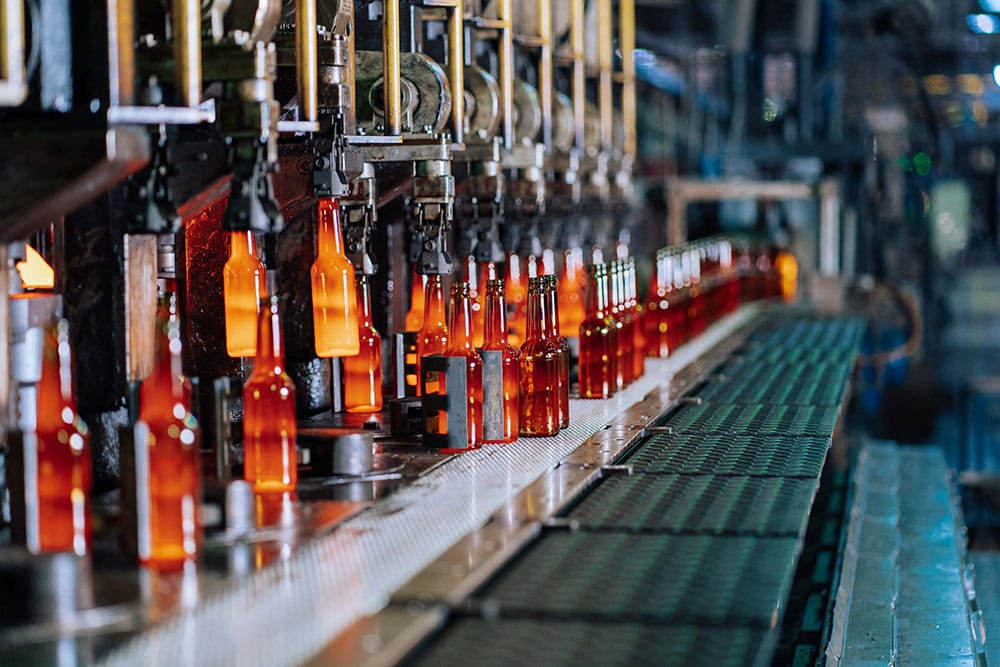
Food and beverage processing places a unique set of demands on mechanical components. A bottling line running at thousands of units per hour, a mixing vessel processing batches of dairy product, a conveyor system moving packaged goods through a cold storage facility – in every case, the machinery must meet two requirements simultaneously: it must perform reliably, and it must not contaminate the product.
This dual obligation sets food and beverage apart from most other industrial bearing applications. In a steel mill or a mining operation, a bearing failure is a maintenance problem. In a food processing facility, it can be a product recall. The consequences extend beyond equipment downtime to regulatory compliance, brand reputation, and consumer safety. Bearing selection in this industry is therefore not purely a mechanical decision – it is also a hygiene and risk management decision.
Food and beverage equipment spans a wide range of machinery – filling and capping lines, conveyors, mixers, homogenizers, centrifuges, packaging machines, refrigeration compressors, and CIP cleaning systems – each presenting distinct requirements by application and processing environment. Deep groove ball bearings, stainless steel bearings, and spherical roller bearings address the majority of these requirements, with material specification and sealing design often as critical as bearing geometry.
Products
Deep Groove Ball Bearings
The most widely used bearing type across food and beverage processing lines. Deep groove ball bearings appear throughout conveyor systems, packaging machinery, bottling lines, and motor-driven ancillary equipment – wherever rotational motion needs to be supported under moderate loads at consistent speeds. In food processing environments, standard carbon steel bearings are frequently replaced by variants engineered for the specific demands of the industry: food-grade grease lubrication, enhanced corrosion-resistant coatings, or full stainless steel construction depending on the proximity to product contact zones. Sealed designs (2RS) are standard, eliminating both relubrication requirements and the risk of lubricant contamination entering the product stream.
Stainless Steel Bearings
In direct or close-proximity product contact zones – filling nozzle assemblies, conveyor sections inside processing rooms, mixing shaft supports, and anywhere subject to frequent washdown with water, steam, or chemical cleaning agents – stainless steel bearings are the correct specification. Constructed from martensitic or austenitic stainless steel, these bearings resist the corrosion that would rapidly degrade standard carbon steel components under repeated CIP and SIP cleaning cycles. They are also compatible with the aggressive cleaning chemicals used in dairy, beverage, and meat processing facilities. The trade-off is a modest reduction in load capacity and fatigue life compared to standard bearing steel – a compromise that is almost always justified by the elimination of contamination risk and extended service life in wet environments.
Spherical Roller Bearings
In the heavier processing equipment – industrial mixers, centrifuges, large conveyors handling bulk ingredients, and grain or sugar processing machinery – spherical roller bearings provide the load capacity and misalignment tolerance that lighter bearing types cannot deliver. Processing equipment of this scale experiences significant shaft deflection under load, and mounting alignment cannot always be maintained to the precision that rigid bearings require. The self-aligning geometry of spherical roller bearings accommodates these conditions without generating damaging edge loads on the rolling elements. In applications where both high load and reliable sealing are required, spherical roller bearings in food-grade sealed configurations provide a practical solution for positions that would otherwise require frequent inspection and relubrication.
Get a Fast Response from Our Team
Share your bearing requirements or project details — our team will review your inquiry and respond with the right product recommendations and pricing.
ETERNUM MOTION TECHNOLOGY
Send an Inquiry
FAQs
What loads can deep groove ball bearings handle?
Deep groove ball bearings are primarily designed for radial loads, but they can also handle moderate axial (thrust) loads in both directions. They are not suitable for heavy axial loads or combined shock loads. In those cases, angular contact or tapered roller bearings are preferred.
How do I select the right bearing size for my application?
Selection should be based on bore diameter (shaft size), required load capacity (dynamic rating C and static rating C0), operating speed compared with the bearing limiting speed, available space (outer diameter and width), and required precision grade from P0 to P2. Always apply a safety factor and verify that the calculated L10 service life meets your requirements.
What is the difference between open, shielded (ZZ), and sealed (2RS) bearings?
Open: No built-in protection, requires external sealing, and is suitable for clean environments or oil bath lubrication.
ZZ metal shields: Protect against dust and debris with low friction, making them suitable for high-speed applications, but they are not waterproof.
2RS rubber seals: Provide strong protection against dust and moisture. They are pre-greased and ideal for contaminated environments, but generate slightly more friction.
How often should I lubricate or replace the grease?
For general industrial use, grease should be replenished or replaced every 3,000 to 10,000 operating hours depending on speed, temperature, and environmental conditions. Bearings running above 70 C or in contaminated environments require shorter intervals. Sealed 2RS bearings are pre-greased for life and do not require re-lubrication.
What are the common causes of premature bearing failure?
The most frequent causes include inadequate or improper lubrication, contamination by dirt, dust, or moisture, incorrect installation, misalignment, excessive force during fitting, overloading beyond the rated capacity, improper shaft or housing fits, and fatigue at the end of normal service life.
How is the rated service life (L10) of a bearing calculated?
The basic L10 life is calculated as L10 = (C / P)^3 x 10^6 revolutions, where C is the dynamic load rating in kN and P is the equivalent dynamic bearing load in kN. It represents the number of revolutions that 90% of identical bearings will complete without fatigue failure. In practice, ISO 281 modified life calculations also apply correction factors for lubrication, contamination, material, and reliability.