Why Bearing Selection Matters More Than You Think
Most people don’t think about bearings until something goes wrong — a machine starts vibrating, a motor runs hot, or a piece of equipment fails ahead of schedule. At that point, the root cause often traces back to the same place: the wrong bearing was installed for the job.
Bearings are the unsung workhorses of mechanical systems. Their job is straightforward — reduce friction between moving parts and support rotational or linear motion. But not all bearings are built the same, and using a deep groove ball bearing where a tapered roller bearing is needed, for example, can cut equipment life dramatically and lead to unplanned downtime.
This guide walks through the most common bearing types, where each one is used, and what to look for when making a selection decision — written for engineers, procurement teams, and anyone responsible for keeping equipment running reliably.
Common Bearing Types and Their Applications
Deep Groove Ball Bearings
Deep groove ball bearings are the most widely used bearing type in the world. Their design is simple: an inner ring, an outer ring, a set of steel balls, and a cage to keep the balls evenly spaced. That simplicity is a feature — they’re versatile, cost-effective, and capable of handling both radial and moderate axial loads in either direction.
They perform well at high speeds and generate relatively low noise, making them a natural fit for applications where quiet operation matters.
Typical applications: Electric motors, household appliances (washing machines, fans, air conditioners), power tools, small pumps, bicycles.
Choose this type when: Load levels are moderate, rotational speed is high, and low noise is a priority.
Angular Contact Ball Bearings
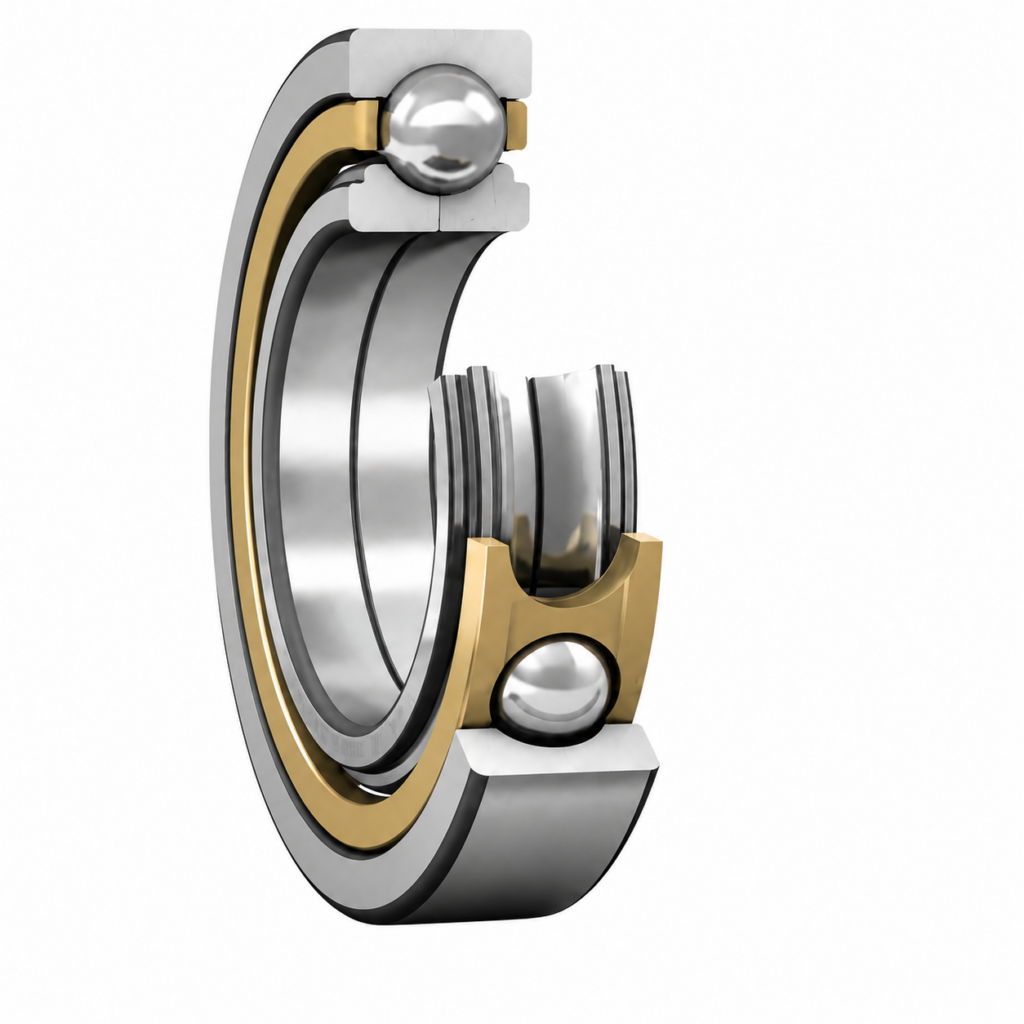
Angular contact ball bearings are designed to handle combined radial and axial loads simultaneously. The key difference from deep groove ball bearings lies in the contact angle — the line connecting the contact points between the ball and the raceways is set at an angle (typically 15°, 25°, or 40°), which allows the bearing to carry thrust loads more effectively.
Because they can only support axial loads in one direction per bearing, they are commonly installed in pairs — back-to-back or face-to-face — to handle thrust from both directions.
Typical applications: Machine tool spindles, automotive wheel hubs, high-speed centrifugal pumps, precision instruments, gearboxes.
Choose this type when: The application involves both rotational loads and significant axial (thrust) forces, and precision matters.
Tapered Roller Bearings
Where ball bearings use spherical rolling elements, tapered roller bearings use conical rollers arranged at an angle. This geometry allows them to carry heavy combined radial and axial loads — significantly more than ball bearings of comparable size. The tapered design means the rollers and raceways converge at a common point on the bearing axis, ensuring pure rolling contact and efficient load distribution.
They require careful axial adjustment during installation and are typically mounted in opposing pairs to manage thrust in both directions.
Typical applications: Automotive transmissions, differentials, heavy truck wheel ends, construction and mining equipment, industrial gearboxes.
Choose this type when: Loads are heavy, shock or impact loading is possible, and the application demands a robust solution over a long service life.
Spherical Roller Bearings
Spherical roller bearings are built for tough conditions. Their double-row barrel-shaped rollers and spherical outer raceway give them a self-aligning capability — they can accommodate shaft deflection and misalignment without sacrificing performance. This makes them especially useful in applications where long shafts are prone to bending, or where installation precision is difficult to achieve.
They offer high load capacity, both radial and axial, and are among the most rugged bearing designs available.
Typical applications: Mining equipment, paper mills, wind turbines, heavy reducers, conveyors, marine propulsion systems.
Choose this type when: Loads are heavy, the shaft is long or flexible, and misalignment due to installation or deflection is a realistic concern.
Thrust Ball Bearings
Thrust ball bearings are purpose-built to carry axial loads — forces acting along the axis of the shaft. Unlike the bearing types above, they are not designed to handle radial loads and should not be used where significant radial forces are present. They are best suited to low-speed applications.
Typical applications: Crane hooks, automotive steering columns, rotary tables, valves, vertical shaft applications.
Choose this type when: The primary load is axial, rotational speed is low, and no significant radial load is present.
Linear Bearings
Linear bearings are a different category altogether. Instead of supporting rotational motion, they are designed for precision linear (straight-line) movement along a shaft or rail. They offer very low friction and are commonly found in automated and precision-driven systems.
Typical applications: CNC machines, 3D printers, automated production lines, medical devices, semiconductor equipment.
Choose this type when: The application requires smooth, precise straight-line motion rather than rotation.
Key Factors to Consider When Selecting a Bearing
Understanding the bearing types is only half the equation. Getting the selection right requires matching those types to the real-world demands of your application. Here are the most important variables to evaluate:
Load Type and Magnitude
Start by identifying the direction and size of the load. Radial loads act perpendicular to the shaft; axial (thrust) loads act along the shaft axis. Many applications involve a combination of both. As a general rule, roller bearings carry heavier loads than ball bearings of the same size, and bearings with a larger contact area distribute load more effectively and last longer under heavy-duty conditions.
Operating Speed
Every bearing has a speed limit. Ball bearings generally tolerate higher speeds than roller bearings, due to lower rolling contact stress at high RPM. Always check the bearing manufacturer’s speed rating — both the thermal reference speed and the limiting speed — and ensure your operating conditions fall within those boundaries with a reasonable safety margin.
Working Environment
Environmental conditions are often underestimated in bearing selection. Key questions to ask:
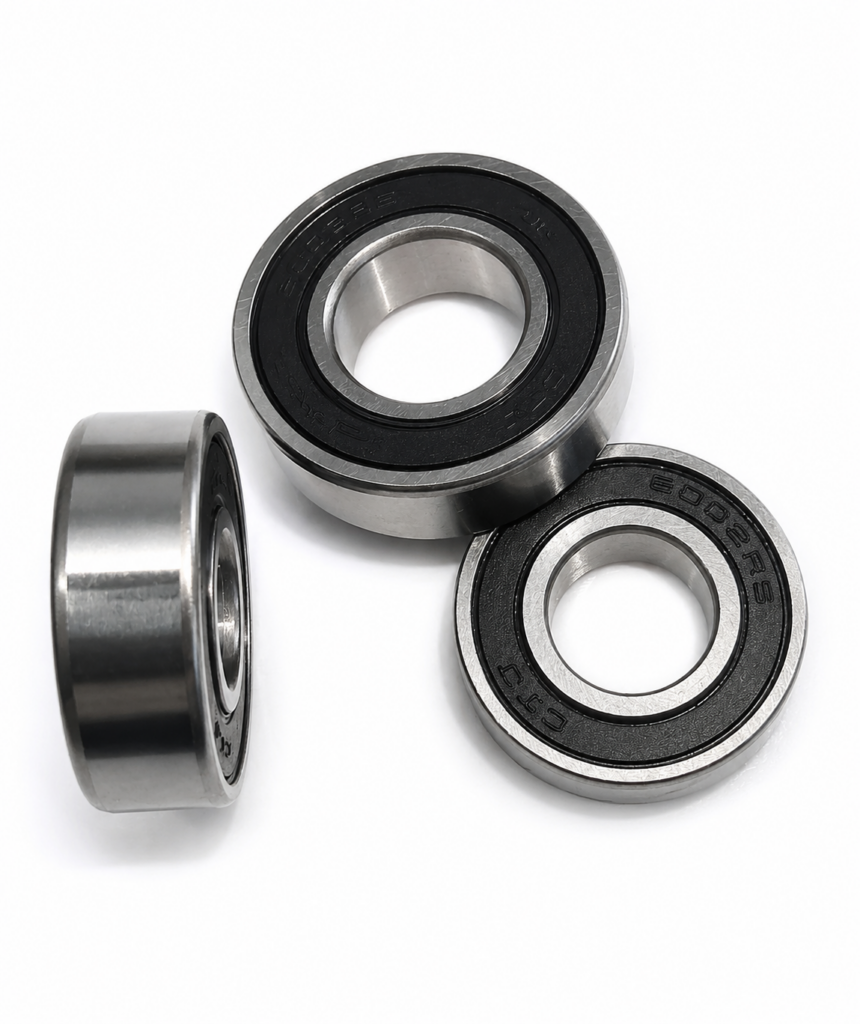
- Contamination: Is the environment dusty, wet, or chemically aggressive? If so, sealed or shielded bearings (designated with ZZ or 2RS suffixes) can significantly extend service life by keeping contaminants out and lubricant in.
- Temperature: High operating temperatures affect both the bearing steel and the lubricant. Bearings used above 120°C may require heat-stabilized variants, high-temperature grease, or specific material grades.
- Vibration and shock: Applications subject to impact or vibration benefit from bearings with greater internal clearance (C3 or C4 class), which provides more room for thermal expansion and reduces the risk of preload-induced damage.
Alignment and Installation Accuracy
If shaft deflection or housing misalignment is expected — common in long shafts, poorly supported structures, or field-assembled equipment — self-aligning bearing types offer built-in error tolerance. Spherical roller bearings and self-aligning ball bearings can accommodate several degrees of misalignment without significant loss of performance or life.
Maintenance Requirements
Some operating environments allow regular relubrication; others don’t. For equipment in hard-to-reach locations or with minimal maintenance schedules, sealed maintenance-free bearings are the practical choice. For heavy-duty industrial equipment, bearings with grease nipple provisions allow scheduled relubrication to be factored into the maintenance plan.
Service Life Expectations and Budget
Bearing service life is typically expressed as L10 life — the number of operating hours at which 90% of a group of identical bearings under identical conditions are expected to still be running. Higher precision grades, better materials, and reputable manufacturers can all push this number up, but they come at a cost. For critical components where unplanned downtime is expensive, investing in higher-specification bearings is usually justified. For non-critical positions, standard grades are often more than adequate.
A Practical Checklist Before You Specify
Before finalizing any bearing selection, make sure you can answer the following:
- What is the maximum load, and in which direction does it act?
- What is the operating speed range?
- What are the temperature and environmental conditions?
- Is there any expected shaft deflection or installation misalignment?
- What are the maintenance access and frequency constraints?
- What is the required service life?
These questions don’t require a mechanical engineering degree to answer — they just require a clear picture of how the equipment will actually be used. With that information in hand, selecting the right bearing type becomes a much more straightforward process.
Final Thoughts
Bearing selection isn’t about picking the most expensive option or defaulting to whatever was used last time. It’s about matching the bearing’s design characteristics to the real demands of your application — load, speed, environment, alignment, and service expectations.
When those factors are addressed systematically, the right bearing type becomes clear. And when the right bearing is in the right place, equipment runs longer, maintenance costs drop, and unplanned failures become the exception rather than the rule.
If you’re working through a specific application and unsure where to start, consulting directly with an experienced bearing supplier — one who understands both the technical specifications and the application context — is always a worthwhile step.