Introduction
Bearings are among the most fundamental components in mechanical transmission. Despite their simple appearance, differences in materials and manufacturing processes directly determine whether a bearing will perform reliably over its intended service life.
Problems often have nothing to do with specification errors — the right type, the right clearance, yet the bearing fails well ahead of schedule. In many cases the root cause lies in the metal material itself: insufficient cleanliness in the steel, inadequate heat treatment, or substandard substitutes passed off as the real thing.
This article focuses on bearing metal materials — what the industry standards are, where common problems occur, and how to make a basic assessment of what you have in hand.
1. Rings and Rolling Elements: High-Carbon Chromium Bearing Steel GCr15
Why It Is the Industry Benchmark
GCr15 (international equivalents: 100Cr6, ASTM 52100, SUJ2) is the most widely used material for bearing rings and rolling elements worldwide. Its key advantages are:
- High carbon content ensures hardness after quenching, typically HRC 60–66
- Chromium alloying promotes fine, evenly distributed carbides, reducing local stress concentration
- Proven contact fatigue life under standard operating conditions — the reference material for bearing life calculations
Steel Cleanliness — The Root of Variation Within the Same Grade
GCr15 defines a chemical composition, not a manufacturing process. Steel produced to this grade can vary significantly in non-metallic inclusion content depending on how it was melted.
Inclusions — oxides, sulfides, and similar impurities trapped within the steel — are the initiation points for rolling contact fatigue cracks. Higher inclusion content means earlier crack initiation, shorter service life, and less predictable failure.
Vacuum degassing (VD/VAD) reduces oxygen content in the melt from the 20–30 ppm range typical of standard electric arc furnace production down to below 10 ppm. The resulting improvement in fatigue life is substantial. This is one of the main reasons why two bearings carrying the same GCr15 designation can differ significantly in both price and performance.
Requesting a Mill Certificate from the supplier — confirming the melting process and inclusion rating — is the most direct way to verify steel quality at the procurement stage.
Common Heat Treatment Problems
Correct material means nothing if the heat treatment is wrong. The goal for GCr15 is a fine tempered martensite structure with hardness of HRC 60–66. Three common problems appear in practice:
Insufficient hardening depth: Bearing rings require through-hardening. If quench depth is inadequate, hardness drops off quickly below the surface — precisely where rolling contact fatigue generates its highest subsurface shear stress. The result is premature spalling.
Surface decarburization: Poor atmosphere control during heating causes carbon loss at the surface, reducing hardness and wear resistance. Abnormal surface wear appears early in service.
Excess retained austenite: Insufficient tempering leaves retained austenite that gradually transforms in service, causing slight dimensional changes. In precision applications this leads to fit loosening or clearance shift; in general industrial use it often shows up as abnormal vibration.
A simple check: Rockwell hardness testing of the ring. A reading below HRC 58 is grounds to question either the material or the heat treatment.
2. Stainless Steel Bearings (440C): Use Where It Is Actually Needed
When It Makes Sense
440C martensitic stainless steel contains approximately 17% chromium, giving it far better corrosion resistance than GCr15. Appropriate applications include:
- Wet or water-contact environments
- Food processing and medical equipment
- Mildly corrosive media
In these conditions GCr15 bearings corrode and fail quickly. 440C is the correct choice.
The Trade-Off
After heat treatment, 440C reaches approximately HRC 58–62 — slightly below GCr15. Contact fatigue life is correspondingly lower, typically by around 20–30%. Using 440C in standard industrial applications that have no corrosion requirement means paying more for shorter life. It is not an upgraded material; it is a purpose-specific one.
It is also worth noting that 440C has limits. Strong acids, strong alkalis, and high-chloride environments will still cause corrosion. It should not be treated as universally corrosion-proof.
Coated Steel Passed Off as Stainless
Bearings made from standard steel with a nickel or chrome surface coating can look similar to stainless steel. The coating degrades quickly in corrosive environments, offering little real protection.
How to check: Use a magnet. 440C is martensitic and weakly magnetic — a magnet will hold but with noticeably reduced pull. GCr15 is strongly magnetic. Comparing the two side by side makes the difference clear.
3. Cage Materials
Stamped Low-Carbon Steel Cages
The standard configuration for most low-to-medium speed, moderate load applications. Cost-effective and widely used.
The main risk is in steel sheet quality and stamping precision. Uneven sheet thickness or poor stamping tolerances produce cages with insufficient strength, which can deform under high-speed or impact loading, jamming the rolling elements and causing immediate bearing failure. At incoming inspection, checking cage wall thickness consistency and pocket uniformity is a straightforward and useful quality check.
Solid Brass Cages
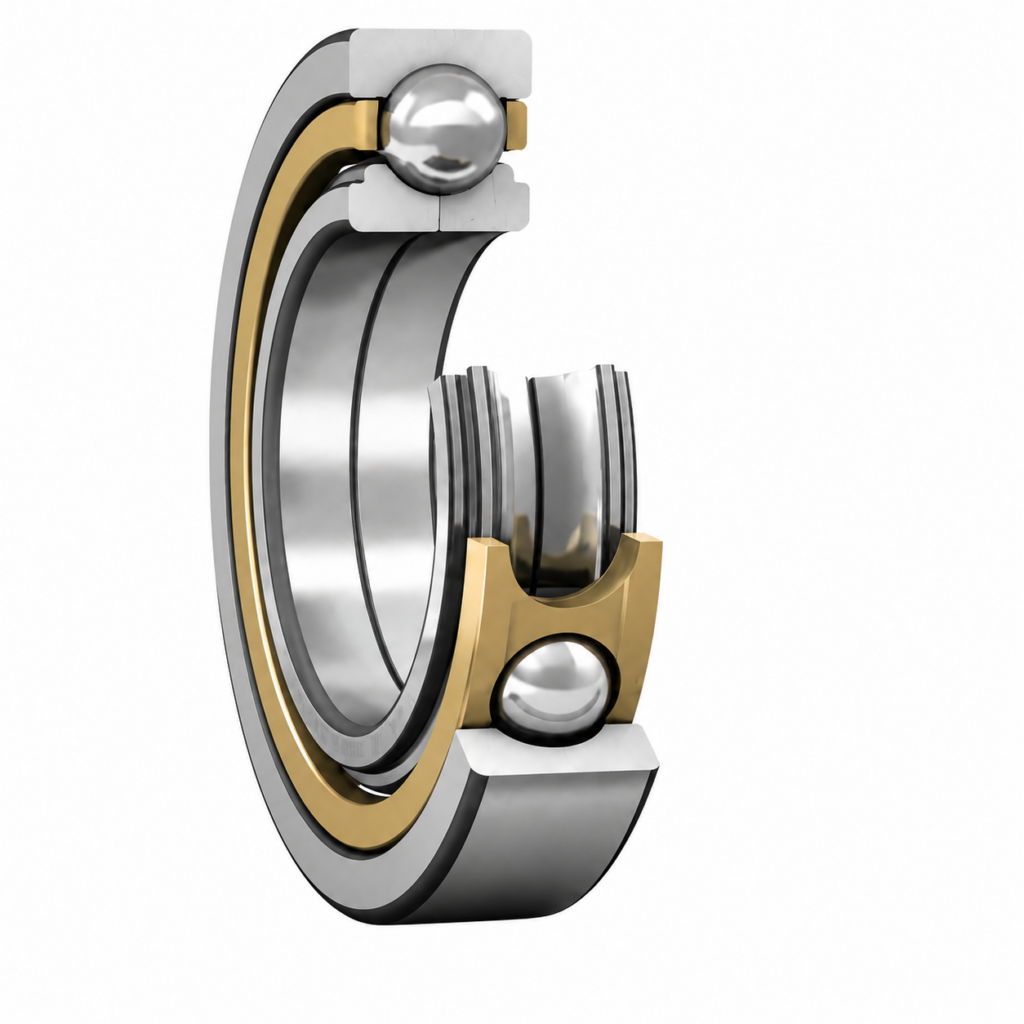
Machined from brass (copper-zinc alloy), these offer higher strength, better thermal conductivity, and lower friction against the rolling elements. They are suited to high-speed and high-temperature applications, and carry a significantly higher price than stamped steel cages.
Identifying substitutes: Magnetic test. Brass is non-magnetic. Iron-based alloys are magnetic. A cage claimed to be brass that a magnet sticks to is not brass.
4. Incoming Inspection in Practice
Hardness check: Ring hardness should fall between HRC 60–66. Readings below HRC 58 warrant further investigation before accepting the batch.
Visual inspection: Ball surfaces should be smooth and bright, free of scratches, oxidation marks, or visible machining marks. Ring surfaces should show no cracks or laps.
Marking inspection: Engraved markings should be clear, uniform in depth, and evenly spaced. Blurred or uneven markings are a sign of poor manufacturing quality.
Fracture inspection (destructive, sample basis): A normal GCr15 fracture surface is fine-grained and uniform grey. Coarse grain, bright spots (inclusions), or visible layering indicate poor steel homogeneity.
5. Summary Table
| Component | Standard Material | Common Problems | How to Check |
|---|---|---|---|
| Rings / Rolling elements | GCr15, vacuum degassed | Low cleanliness, inadequate heat treatment | Hardness test, fracture inspection, Mill Certificate |
| Rings (corrosion-resistant) | 440C stainless steel | Coated plain steel passed as stainless | Magnet test (440C weakly magnetic) |
| Cage (standard) | Stamped low-carbon steel | Uneven sheet, poor stamping precision | Visual thickness and pocket uniformity check |
| Cage (high-speed) | Solid brass | Iron alloy passed as brass | Magnet test (brass non-magnetic) |
Conclusion
Material problems rarely show up visually. They typically surface months into service as unexplained temperature rise, early spalling, or unscheduled downtime.
The preventive steps are straightforward: request a Mill Certificate at procurement, carry out hardness spot checks on receipt, and use a magnet for basic material verification. These require minimal time and cost, and will catch the majority of obvious material issues before they reach the machine.
Reference standards: GB/T 18254, ASTM A295, ISO 683-17