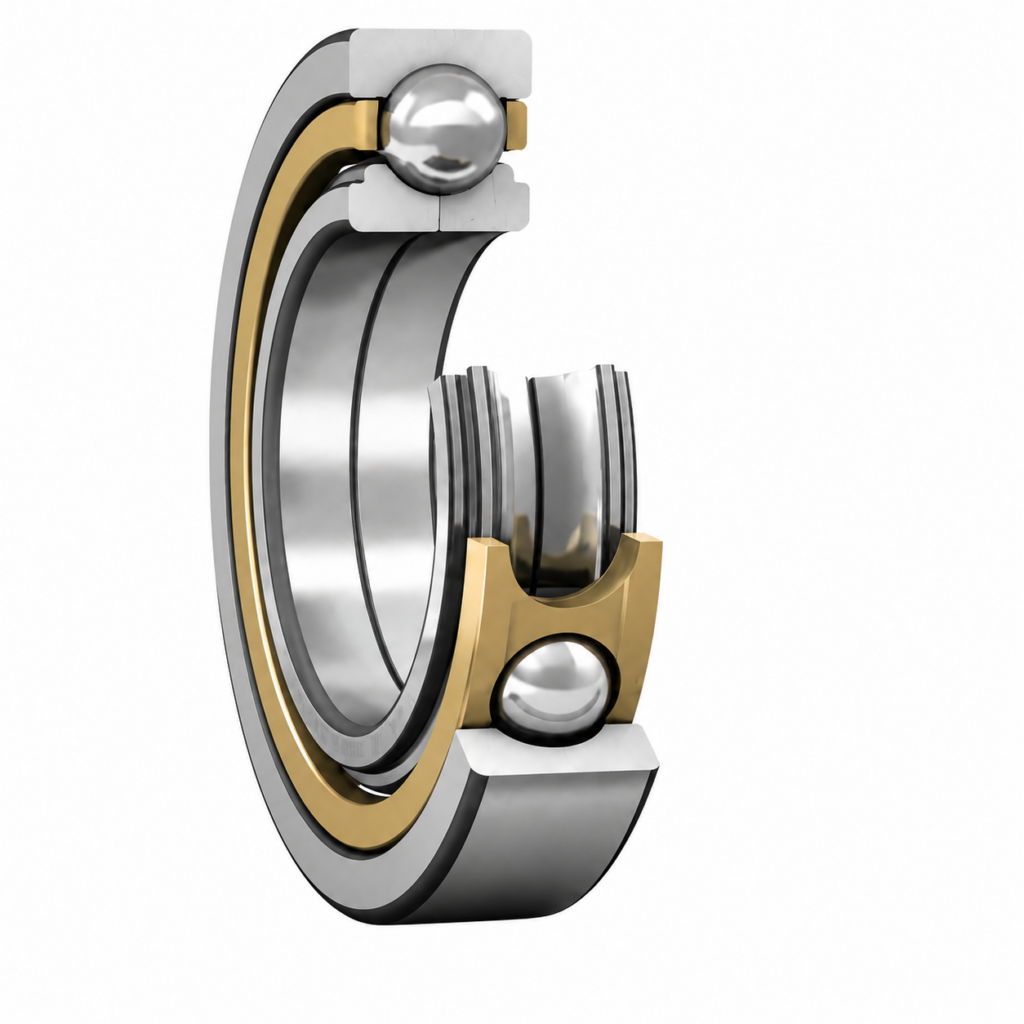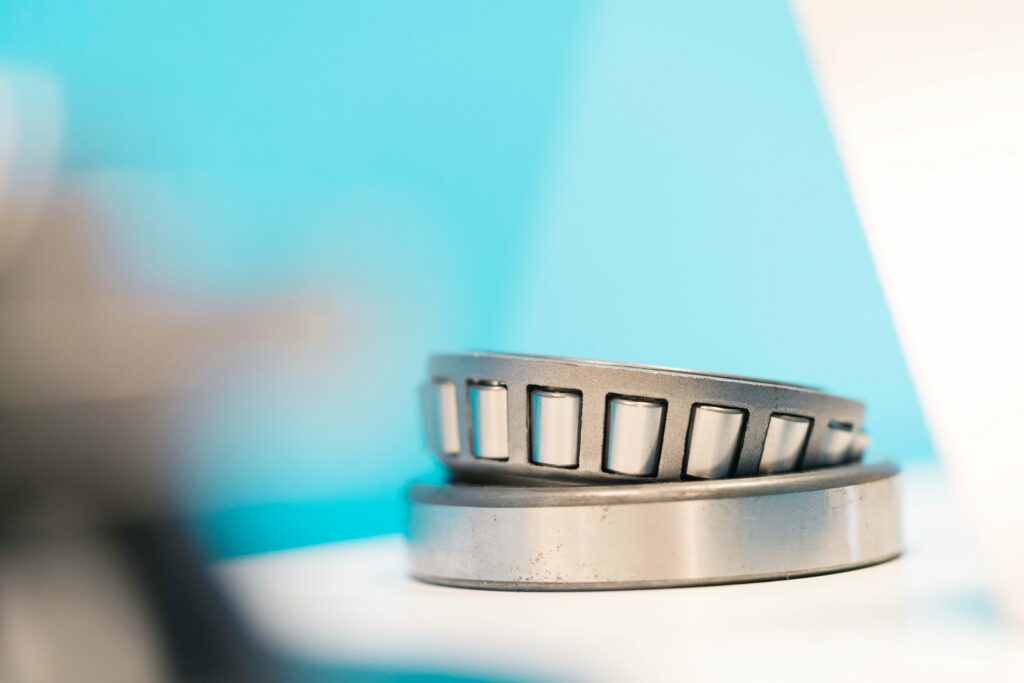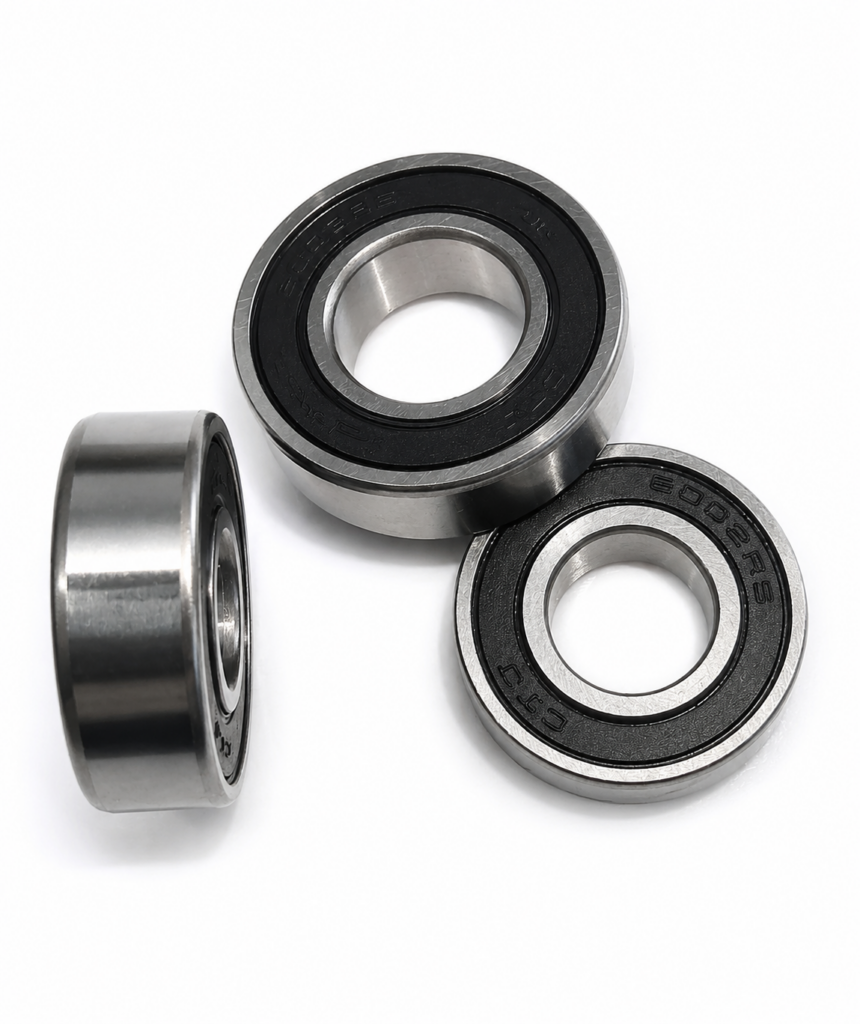
Thrust bearings are a specialized category of rolling bearing designed to handle axial (thrust) loads — forces acting parallel to the shaft’s axis of rotation — rather than the radial loads that most other bearing types primarily support. Wherever a shaft needs to push or pull against a stationary surface while rotating, a thrust bearing is the component that absorbs that force efficiently and smoothly. In this guide, we’ll explore the structure, working principle, key features, common configurations, selection criteria, and typical applications of thrust bearings.
What Is a Thrust Bearing?
A thrust bearing is a rolling-element bearing specifically engineered to support axial loads — loads that act along the same direction as the shaft’s rotational axis. Unlike deep groove ball bearings or cylindrical roller bearings, which are optimized primarily for radial loads, thrust bearings are oriented so that their rolling elements run perpendicular to the shaft, allowing them to absorb force pushing or pulling along the shaft’s length.
Thrust bearings are typically used in applications where a rotating shaft also experiences significant axial force — such as a car’s manual transmission gears pushing against each other, or a vertical pump shaft supporting the weight of rotating components above it.
Structure and Components
A typical thrust bearing consists of the following components:
- Shaft Washer – The ring that mounts against the rotating shaft and rotates along with it.
- Housing Washer – The ring that sits against the stationary housing and remains fixed.
- Rolling Elements – Balls, cylindrical rollers, needle rollers, or spherical rollers, depending on the bearing type, arranged in a single plane to transfer axial force between the two washers.
- Cage (Retainer) – Maintains even spacing of the rolling elements and prevents them from contacting one another.
Unlike radial bearings, where the inner and outer rings are concentric, thrust bearing washers are stacked axially — one rotating, one stationary — with the rolling elements sandwiched between them in a flat, disc-like arrangement.
Working Principle
The working principle of a thrust bearing relies on positioning rolling elements so their rolling axis is perpendicular to the shaft’s rotational axis, rather than parallel to it as in radial bearings. This orientation allows the rolling elements to directly resist force pushing along the shaft’s length while still permitting free rotation.
There are two primary configurations based on load direction:
- Single-Direction Thrust Bearings – Designed to support axial load in one direction only. If the load reverses, the bearing components can separate, so these are only suitable for applications with a consistent, unidirectional thrust force.
- Double-Direction Thrust Bearings – Feature a central shaft washer with housing washers on both sides, allowing the bearing to support axial loads in either direction — useful in applications where thrust force may reverse, such as some gearbox or pump configurations.
Compared to radial bearings, which excel at supporting loads perpendicular to the shaft, thrust bearings are purpose-built for the opposite load direction, and most standard thrust bearing designs offer little to no radial load capacity unless specifically designed as a combined bearing.
Key Features and Advantages
- Dedicated Axial Load Support – Specifically engineered to handle thrust forces that radial bearings cannot efficiently absorb.
- Simple, Predictable Installation Orientation – The flat, stacked washer design makes correct installation direction relatively easy to identify and verify.
- Variety of Rolling Element Options – Choice between balls, cylindrical rollers, needle rollers, or spherical rollers allows engineers to match load capacity, speed, and space requirements.
- Combinable with Radial Bearings – Thrust bearings are frequently paired with radial bearings (such as deep groove ball or cylindrical roller bearings) in the same assembly to handle combined radial and axial loading.
- Compact Axial Footprint Options – Thrust needle roller bearings, in particular, offer very thin axial profiles for space-constrained applications.
Common Types and Configurations
Thrust bearings come in several standard types, each suited to different load, speed, and space requirements:
- Thrust Ball Bearings – Use balls as rolling elements; available in single-direction and double-direction configurations. Well-suited to light-to-moderate axial loads at moderate to high speeds, commonly used in steering systems and machine tool spindles.
- Cylindrical Roller Thrust Bearings – Use cylindrical rollers arranged radially around the bearing axis, providing higher axial load capacity than ball versions but at generally lower speed limits, due to increased friction from line contact.
- Needle Roller Thrust Bearings – Use needle rollers arranged in a thin, flat cage, offering very high load capacity relative to their extremely thin axial section — ideal for space-constrained gearboxes and compact assemblies.
- Spherical Roller Thrust Bearings – Use barrel-shaped (spherical) rollers, allowing the bearing to accommodate some self-aligning capability and a degree of combined radial loading alongside the primary axial load; commonly used in heavy-duty applications such as vertical pumps and marine propulsion systems.
Common Designations, Sizes, and Materials
Thrust bearings follow standardized numbering systems that differ from radial bearing conventions. Many thrust ball bearings, for example, use a “5xxxx” series designation under ISO standards, while thrust roller bearings often follow separate manufacturer-specific or ISO-based numbering depending on roller type.
Common materials include:
- Bearing-Grade Chrome Steel – The standard material for shaft washers, housing washers, and rolling elements, offering good hardness and fatigue resistance under repeated axial loading.
- Case-Hardened Steel – Used in heavy-duty roller thrust bearings to improve surface durability while maintaining a tough core.
- Corrosion-Resistant Alloys – Used in marine, chemical processing, or other environments with high exposure to moisture or corrosive substances.
How to Select the Right Thrust Bearing
Choosing the correct thrust bearing requires evaluating several factors:
- Load Direction – Determine whether the application experiences axial load in one direction only or in both directions, which dictates whether a single-direction or double-direction bearing is required.
- Load Magnitude – Heavier axial loads generally favor roller-type thrust bearings (cylindrical, needle, or spherical) over ball-type designs.
- Rotational Speed – Thrust ball bearings typically support higher speeds than roller types due to lower friction; verify against your application’s RPM requirements.
- Combined Loading Needs – If the application also experiences meaningful radial load, consider a spherical roller thrust bearing or a separate radial bearing paired with the thrust bearing.
- Available Axial Space – For space-constrained designs, needle roller thrust bearings offer the thinnest axial profile for a given load capacity.
- Operating Environment – Consider temperature, contamination exposure, and lubrication method when selecting materials and sealing accessories.
Typical Applications
Thrust bearings are used across a wide range of industries wherever axial force must be managed efficiently:
- Automotive – Manual transmission gear sets, steering column assemblies, and clutch mechanisms.
- Industrial Machinery – Gearboxes, presses, and lifting equipment where axial thrust from gears or screws must be absorbed.
- Machine Tools – Spindle assemblies requiring precise axial positioning alongside rotational motion.
- Pumps and Compressors – Vertical shaft pumps, where the bearing supports the axial weight of rotating components.
- Wind Turbines and Marine Propulsion – Large-scale applications requiring heavy-duty axial load support combined with reliable rotation under variable conditions.
Thrust Bearings vs. Other Bearing Types
| Feature | Thrust Bearing | Deep Groove Ball Bearing | Tapered Roller Bearing |
|---|---|---|---|
| Primary Load Direction | Axial | Radial (moderate axial) | Combined radial + axial |
| Radial Load Capacity | None/Minimal (standard types) | Good | Excellent |
| Axial Load Capacity | Excellent | Moderate | High (one direction per row) |
| Speed Capability | Moderate to High (ball types) | High | Moderate |
| Common Use | Pure axial loading | General purpose | Heavy combined loads |
Conclusion
Thrust bearings fill a critical role that radial bearings cannot efficiently address: absorbing axial forces that act along a shaft’s length. With configurations ranging from thrust ball bearings for moderate, higher-speed applications to roller-type and spherical roller thrust bearings for heavy-duty or combined loading scenarios, engineers have a wide range of options to match specific load, speed, and space requirements. Understanding the structure, working principle, and selection criteria for thrust bearings will help ensure reliable, long-lasting performance in any application where axial load management is essential.
If you’re uncertain which thrust bearing type or configuration best fits your application, consulting a bearing supplier or engineer with your specific load, speed, and space requirements is always recommended.